Skip to content


Vertical Blinds Buying Guide: How to Choose the Right Set for Your Windows


It isn’t easy to cover wide windows or sliding glass doors. Long horizontal slats sometimes hang down all the way across, or sometimes heavy drapes cover the door. This guide will help you choose the right vertical blinds for your windows. First, what types of vertical blinds will fit your room, how much each of these materials costs, how the controls work, and finally, whether vertical blinds are better than other types of window coverings.
You will learn everything about PVC or fabric blinds, straight or curved vanes, controlled by a wand or chain, and which size of vanes to buy. After completing the reading, you should understand which type of blinds to choose and why.
What Makes One Set of Vertical Blinds Better Than Another
The best option is the one suited to the room rather than the least expensive one available. Keep the following in mind when you buy:
-
Wide-angle light control. The slats can be tilted to minimize glare, control light coming through without losing privacy, or be fully closed for total darkness.
-
Great fit for large openings. Vertical blinds are great for use over big windows and sliding glass doors.
-
Less tendency toward dirt accumulation. Since the slats hang in a vertical position, they collect less dirt. A quick wipe with a damp cloth is usually enough to clean them.
-
Much lower price compared to other custom-made draperies of the same width.
-
Get the stack direction right. Vanes should stack away from the handle side of a sliding door so they clear the opening.
The rest of this guide explain each of these benefits.
What Are Vertical Blinds and How Do They Work?
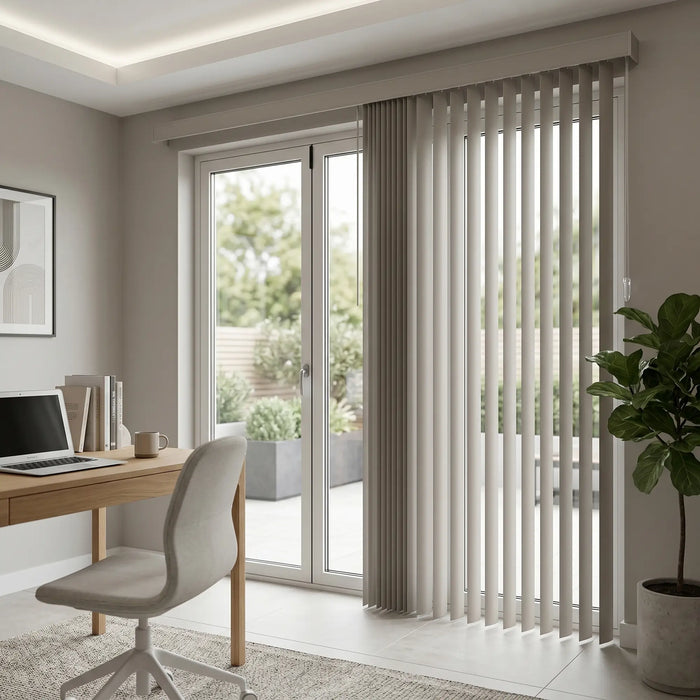
Vertical blinds are window coverings made of long slats, called vertical blind vanes, that hang down from a track at the top and rotate to control light. That top track is the vertical blind headrail. Each vane clips onto a carrier inside the headrail, and a wand or chain lets you tilt every vane up to 180 degrees or slide the whole set to one side to clear the glass.
That two-part motion is what sets them apart from horizontal blinds. Tilt the vanes to angle daylight or close them for privacy. Draw them fully, and the window or door opens with nothing in the way. The vanes are usually made from PVC (vinyl), faux wood, or fabric, and they run from floor to headrail on tall openings.
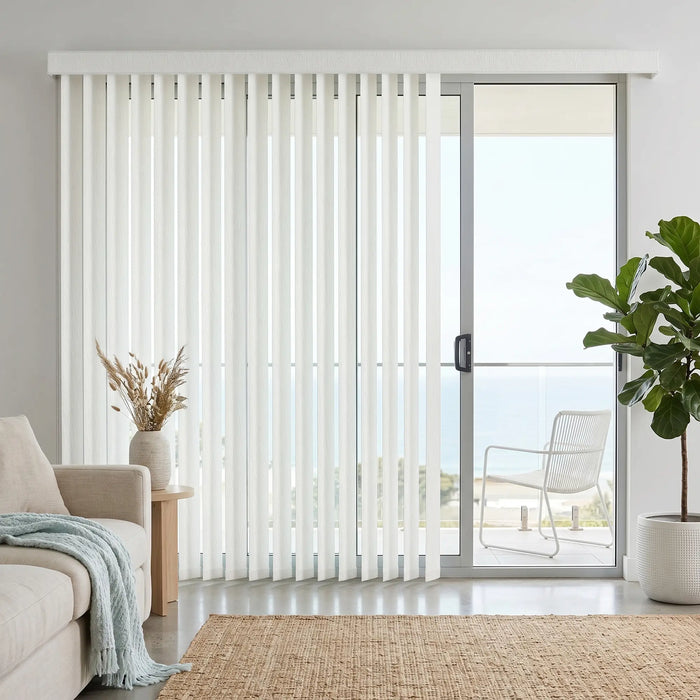
Because the vanes move in the same direction as a sliding door, vertical blinds for patio doors and vertical blinds for sliding glass doors stay practical in a way few other treatments manage. You slide the door, you slide the blinds, done.

The Advantages of Vertical Blinds (and Their Limitations)
The benefits of vertical blinds include ease of controlling light, simplicity of use, and ease of care, but this type of window covering does not fit particular windows. The following are the main advantages and disadvantages to consider:
-
Ability to control light up to 180 degrees. With vertical blinds, it is possible to filter light, allowing only a certain amount to come in while keeping the space private.
-
Suitability for particular shapes of openings. With vertical blinds, you can cover large, wide-open windows, as well as patio doors or windows reaching the ceiling.
-
Almost no dust accumulation. Due to the vertical position, the slats gather dust minimally, so it is enough to just take a damp cloth or a vacuum cleaner in order to clean and freshen them up.
-
Lower price compared to many custom curtain fabrics for the same window size.
Where they fall short:
-
Light leaks between the vanes near the edges, even when closed. If you need a fully blacked-out bedroom, pair fabric vanes with a PVC backing or plan on a room-darkening liner.
-
The vanes sway and tap in a draft or under a ceiling fan. In a quiet bedroom, that soft clatter annoys some people.
My take: buy vertical blinds for wide windows and sliding doors, where they beat the alternatives on both function and cost. For a small, standalone bedroom window, a roller or cellular shade is the quieter choice. If you want to compare the trade-offs in full, our piece on why vertical blinds work so well on wide openings goes deeper, and you can browse custom vertical blinds to see current vane options.
Types of Vertical Blinds by Material
When you are trying to decide which types of vertical blinds to buy, the material of the blinds is the key factor. There are some kinds of vertical blinds, like panel tracks and cellular verticals, that can be used separately, but with vertical blinds, you have to choose from three types of vertical blind materials. Each material is specific to its usability.
PVC and Vinyl Vertical Blinds
PVC vertical blinds are inexpensive and practical. You can put them in any room with a high degree of humidity or traffic. Vinyl vertical blinds do not absorb water, it can be cleaned with a cloth made of a special fabric that is used for cleaning windows, and they can endure humidity in kitchens and bathrooms without becoming warped. PVC vertical blinds are also very likely to block more sunlight than any fabric material.
They are also cheap. For 104.99 dollars, you can buy a complete set of curved PVC blinds. These vertical blinds are placed in the lowest price segment of custom vertical blinds. Their appearance is not so fancy. Wooden and textured are types of PVC vertical blinds.
Faux Wood Vertical Blinds
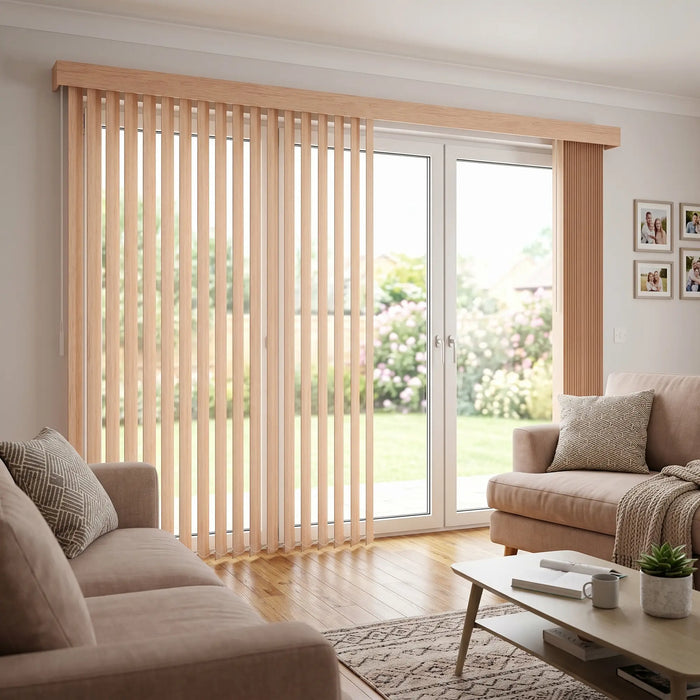
Faux wood vertical blinds allow you to enjoy the beauty of wood grain on large windows without the risk of twisting associated with natural wood due to sunlight and heat. They are made from PVC with a wood-like surface, so they provide moisture resistance similar to vinyl but look a bit closer to a shutter. The price of smooth type models is approximately $117.99, while the ones with wood grain texture are $137.99.
This material is perfect to use on a large sunny sliding door, where a natural wood slat would curve within one season. Choose one of the wooden series in the faux wood vertical blinds collection and match it with your trimmings.
Fabric Vertical Blinds
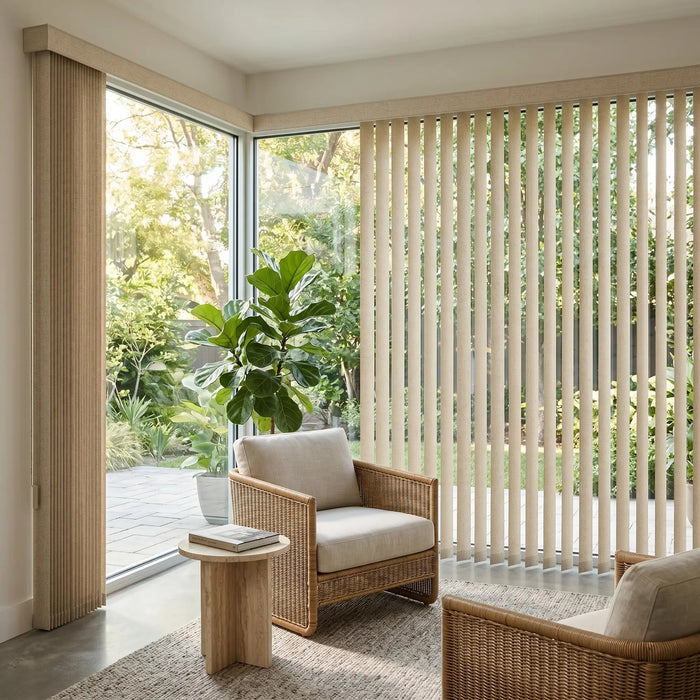
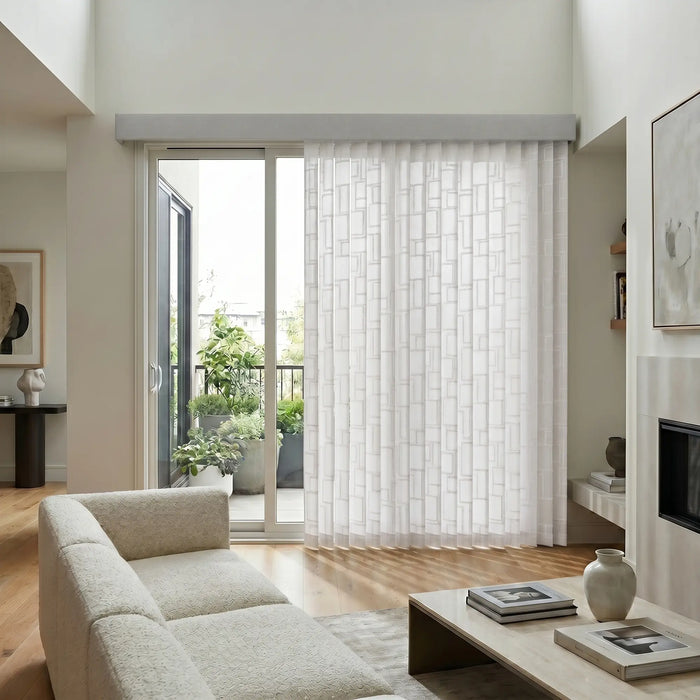
Fabric vertical blinds are produced for those who are looking for a softer, curtain-like appearance instead of a firm slat look. The slats are available in a variety of colors and patterns, and they allow light into the house without blocking it, creating a soft light effect.
The two things to plan for are lighting and cleaning. On their own, fabric vanes are light-filtering vertical blinds, so a bedroom that needs full darkness should use fabric with a PVC backing to turn them into room-darkening vertical blinds. For upkeep, vacuum them with a brush attachment rather than wiping, since fabric holds dust more readily than vinyl. A fabric vertical blinds set like the Signature runs about $247.99, the top of the range, and it earns it on looks.
What About Metal and Real Wood Vertical Blinds?
Even if people are looking for metal and actual wood slats, these options are specialized today. Aluminum vertical slats are long-lasting and inexpensive, but they produce sounds much more noise than PVC and are prone to dents. Actual wood vertical blinds are not only the heaviest option but also the most expensive one. When exposed to the sun, they are going to twist and crack.
S-Shaped vs. Curved Vertical Blinds: What's the Difference?
The difference is the vane's profile, not the window. Both S-shaped vertical blinds and curved vertical blinds describe the shape of the vane seen from above, and that shape changes how much light they block and how they look when closed.
-
Standard curved vertical blinds have a gentle single bow, like a shallow C. It is the classic vertical look and the most common.
-
S-shaped vertical blinds use a double curve. The S profile lets each vane overlap its neighbor a little more when closed, which cuts the light gaps and gives a softer, more drapery-like face. A Signature S-shape set runs about $189.99.
In the debate of S-shaped vertical blinds vs curved vertical blinds, one should choose S-shape when he wants neater appearance in the closed position and greater control over the light in rooms. Meanwhile, choosing curved blinds is the most cost-effective option if one is looking for something simple and standard. The finishing touches also play an important role. The smooth lines of S-shaped blinds give them a chic appearance, while textured vertical blinds are dust- and fingerprint-free and add an interesting dimension to walls. All types of vertical blind styles are made in the same size, so the difference is only in their appearance.
How Much Do Vertical Blinds Cost?
Expect prices to start from roughly $105 for custom vertical blinds, with material type driving most of the difference. At Factory Direct Blinds, current pricing starts from about $104.99 for a curved PVC setup and, on the more premium end, pricing starts at $247.99 for the Signature fabric, with faux wood in between.
Here is how the materials stack up:
-
PVC and vinyl: the lowest cost, from about $104.99. Best value for kitchens, bathrooms, and rentals.
-
Faux wood: mid-range, from about $117.99 to $137.99. The woodgrain look for less than real wood.
-
Fabric: the top of the range, from around $247.99. Buy it for the soft, finished look.
Two numbers to factor in beyond the vanes. Industry-wide, professional installation adds roughly $60 to $300 per window, depending on size, according to Angi's 2026 cost data. Motorization can add up to about $850 for the motor and remote. If price is the deciding factor, our budget-friendly blinds range keeps the function while trimming the cost, and free shipping across the continental US takes the installation kit delivery off the bill.
Slat and Vane Sizes: How Wide Should Vertical Blind Vanes Be?
Unless you have a reason not to, it is advisable to order 3.5-inch vertical blind vanes. The 3.5-inch width (also referred to as 3½-inch) is the standard of the industry and the dimension that is used by Factory Direct Blinds all throughout its vertical assortment. This dimension works for almost all doors and windows that are less than six feet wide, as suggested by Value Blinds' fit guide.
The wider the vanes are, the more modern their appearance is, and as there are fewer of them they do not let so much light pass through. If one needs more traditional-looking slats, then the only possible solution would be to have custom-sized vertical blinds. Each set is cut precisely to the opening, which is no more than one-eighth of an inch; therefore, it provides one with a chance to get the exact number of vanes.
Controls and Customization: Wands, Stacking, and Valances
Choose a wand over a chain, and choose cordless if a home has kids or pets. The control you pick affects daily use more than almost any other option, so this is worth getting right.
-
Vertical blinds with wand control use a single rod to both tilt and draw the vanes. A wand-operated vertical blinds setup is cleaner than a dangling chain, less likely to tangle, and safer since there is no looped cord. Our cordless vertical blinds options remove the pull cord entirely, which the CPSC recommends for households with young children.
-
Chain-and-cord control still exists and gives fine adjustment, but the loop is the part that tangles and poses a hazard.
-
Vertical blind stack options decide which way the vanes bunch when you open them. A one-way stack collects all the vanes on one side; a split-stack set parts them in the middle like curtains. On a sliding door, stack the vanes away from the handle so they clear the opening.
-
A vertical blind valance is a top cap that hides the vertical blind headrail for a finished edge. It is a small add-on that makes the whole set look built-in rather than mounted on.
-
Motorization runs the whole set from a remote and suits high or hard-to-reach openings. It needs a compatible headrail, so check the product first. Our vertical blinds installation guide covers both wand and motorized setups.
Colors, Patterns, and Textures
Match the vane color to the room, then confirm it with a real swatch before you buy. Vertical blind colors run from soft neutrals to bold statement shades, and the right pick depends on whether you want the blinds to disappear or stand out.
-
Neutral colors such as beige, white, and gray can be used as a general basis for any color scheme.
-
Deep colors, like dark blue or dark red, create dramatic effects in your room that can draw so much attention.
-
Standard blinds may require matching fabric with the piece of furniture, like a rug or a sofa, for consistency.
-
Textured vertical blinds add a nice texture and hide dirt and dust on the walls much better than plain.
Screens lie about color. A gray that looks cool on your monitor can read warm on the wall in afternoon light. Before you place a custom order, order free vertical blind samples (up to 10 swatches) and hold them against your paint and furniture in the actual room.
Best Rooms for Vertical Blinds
The best rooms for vertical blinds are the ones with wide glass: living rooms, patio areas, and any space with a sliding door. Here is how to match material to room.
-
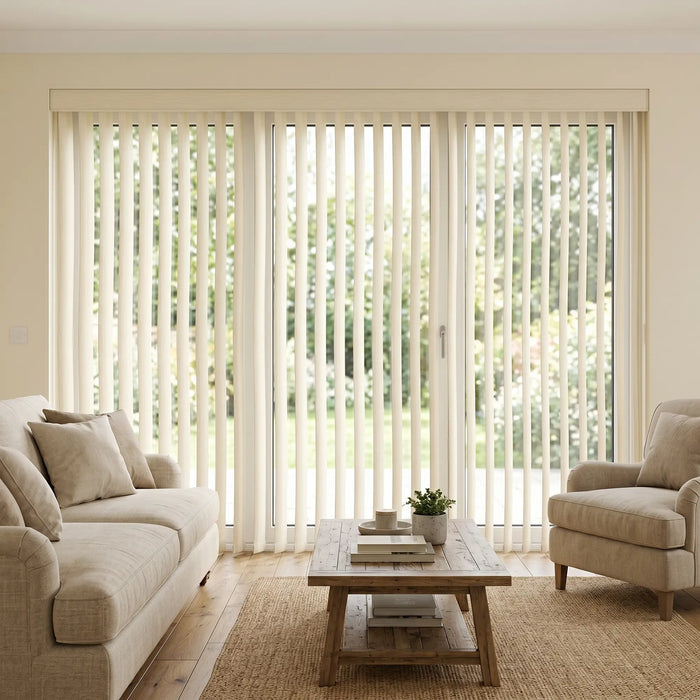
Living rooms and family rooms. Wide windows and patio sliders are where vertical blinds for living rooms shine. Fabric or faux wood vanes keep the look warm. See the living room vertical blinds range for sizing on large spans.
-
Kitchens and bathrooms. Moisture and splashes call for PVC. Vertical blinds for kitchens and baths should be vinyl so you can wipe them down, and our kitchen window coverings range is built for it.
-
Bedrooms. Vertical blinds for bedrooms work best as fabric vanes with a PVC backing for room-darkening, so you get the soft look and the sleep-friendly darkness.
-
Sliding glass and patio doors. This is the flagship use. Vertical blinds for sliding glass doors move with the door and clear the opening in one draw.
If you want them for the whole house, vertical blinds for home use come down to switching material by room rather than picking one vane for everything.
Are Vertical Blinds Still in Style?
Yes, and the modern versions look nothing like the rattling vinyl strips from the 1990s. Today's sets use S-curve vanes that fall like drapery, softer fabrics, sheer options, wider vanes, and quiet motorized headrails, according to design roundups like FSI's 2026 style piece.
They are not the trendiest treatment on the market. Zebra shades and motorized rollers get more attention. But for a sliding door or an extra-wide window, modern vertical blinds solve the problem better than anything else at the price, which is why they are back in new builds and apartments. If you would rather compare them against other wide-window treatments, our guide to vertical blind alternatives covers panel tracks and vertical cellular shades side by side.
How to Measure and Order Your Vertical Blinds
Measure for an inside mount if your window has the depth and you want a clean, recessed look, and an outside mount if you want maximum coverage and less light leak. Measure the width and height in three places each and record the tightest for inside mounts, the fullest for outside. Every set is cut to your numbers within an eighth of an inch.
On the common question of whether vertical blinds should touch the floor, leave about a half-inch gap. Vanes that drag on the floor fray at the tips and catch on the track. Our step-by-step walkthrough on how to measure for vertical blinds covers inside versus outside mount in detail, and ordering free swatches first means you confirm both color and size before the custom cut.
Your Vertical Blinds Buying Guide Checklist
The whole decision comes down to five choices: material by room, S-shape or standard curve, 3.5-inch vanes, wand with a cordless track, and the right stack direction for your door. Get those right, and you have a set that fits the opening and holds up for years.
Run the checklist against your own window. PVC for damp rooms, fabric for soft living spaces, faux wood for wide sunny sliders. Then order free samples to lock the color, and browse the full custom vertical blinds range to place your order. If you get stuck on sizing or material, the Factory Direct Blinds team can talk you through it before you buy.
GET CUSTOM BLINDS FOR YOUR HOME TODAY
FAQs
What Are the Best Vertical Blinds to Buy?
The choice primarily depends on the area. Buy PVC vertical blinds for kitchens, bathrooms, and busy doors where cleaning and moisture are important issues. Fabric vertical blinds should be used in living rooms and bedrooms in areas where a soft, drapery look is desired. Faux wood vertical blinds can be suitable for wide, bright windows that need the appearance of wood grain without the risk of warping. Choose material first, then color.
Is a Wand or Chain Better for Vertical Blinds?
When it comes to the controlling mechanism, a wand is a better option for most homes. It tilts and opens the vanes with one rod, does not get tangled the way a looped chain does, and is safer for children and pets, especially in a cordless version. A chain provides a high level of control but also introduces a risk associated with a cord, which is why the best approach is to pick vertical blinds with wand control unless there are certain reasons not to choose this option.
What Are S-Shaped Vertical Blinds?
S-shaped vertical blinds have vanes that follow S-shaped curves and have a double curve, as opposed to the single arch shape of their standard counterparts. The S profile lets each vane overlap its neighbor slightly when closed, which reduces the light gaps and gives a softer, more upscale look than standard curved vertical blinds. They do not bend to fit odd-shaped windows. The S refers to the vane's cross-section, not the window.
Which Way Should Vertical Blinds Stack?
Position the vanes towards the side that is opposite the door handle so that they don’t hinder the sliding action of the door. A single stack gathers all the vanes together at one side and is a good choice for single slide doors. The split stack arranges the vanes in the middle and works best for symmetrical windows or French doors. Check the location of the handle before ordering the stack direction.
Are Fabric or Vinyl Vertical Blinds Easier to Clean?
When it comes to cleaning, vinyl vertical blinds are simpler than fabric ones. You can just wipe the PVC vanes with a damp cloth, and they are good against damage from moisture. Fabric vertical blinds, however, require a gentle vacuum for dust and careful spot treatments to avoid using hot water or bleach, which could harm the fabric. If the cleaning process is your concern, choose vinyl blinds.
Should Vertical Blinds Touch the Floor?
No. You should leave a little space between the end of the vanes and the floor. When the vanes are touching the floor, they end up dragging, which causes fraying on the tips and misalignment of other moving parts of the vertical blind headrail. Therefore, a small space is needed to allow smooth operation of the vanes.