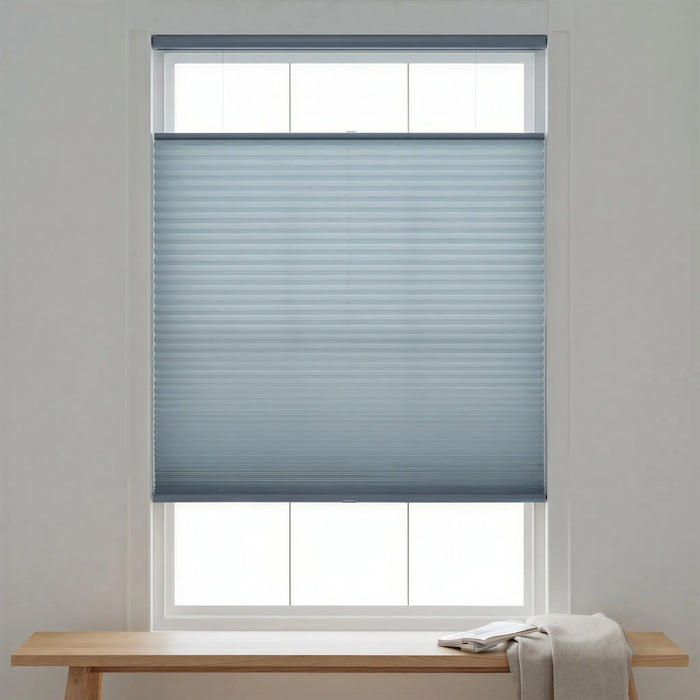
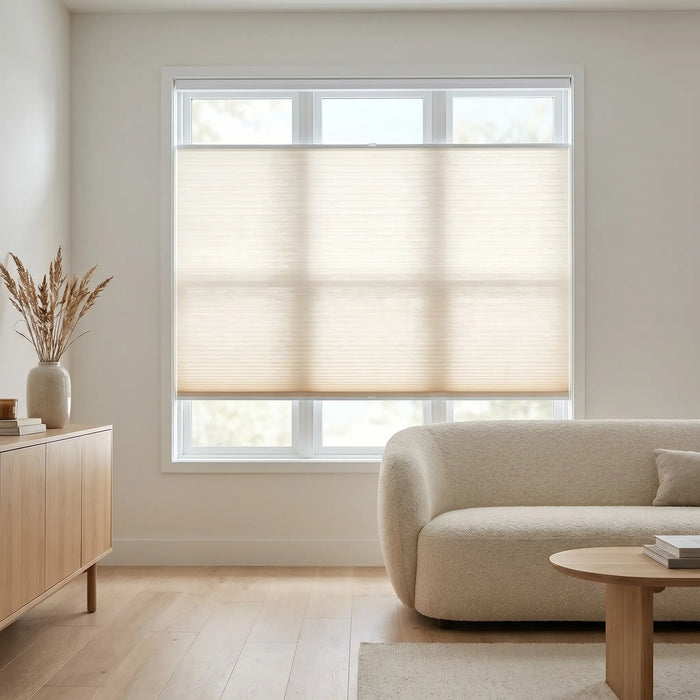
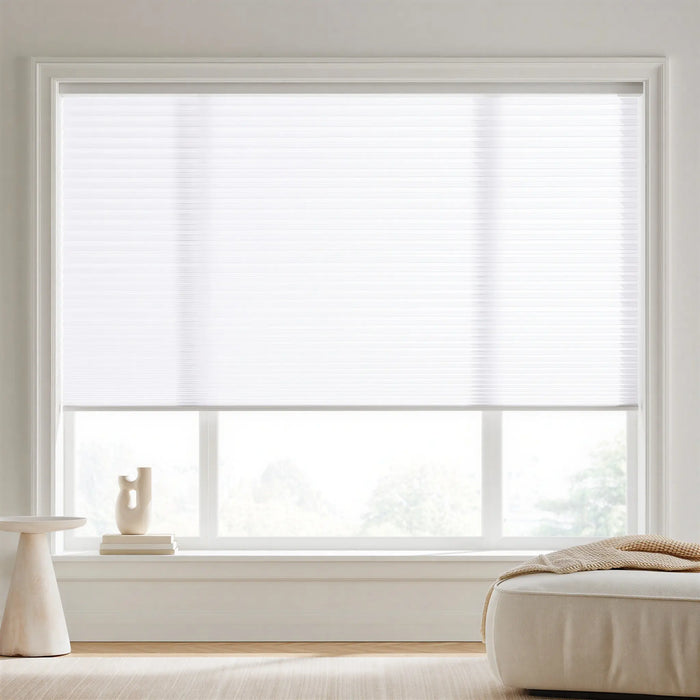
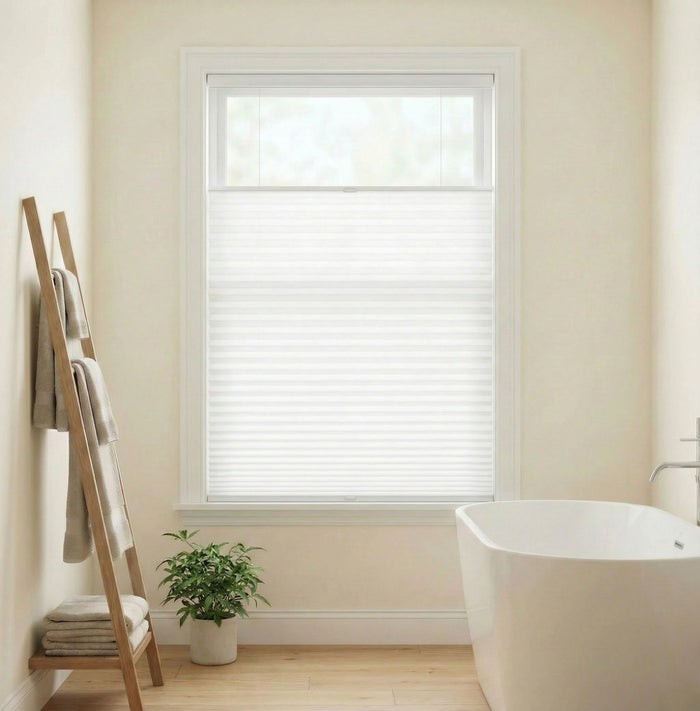
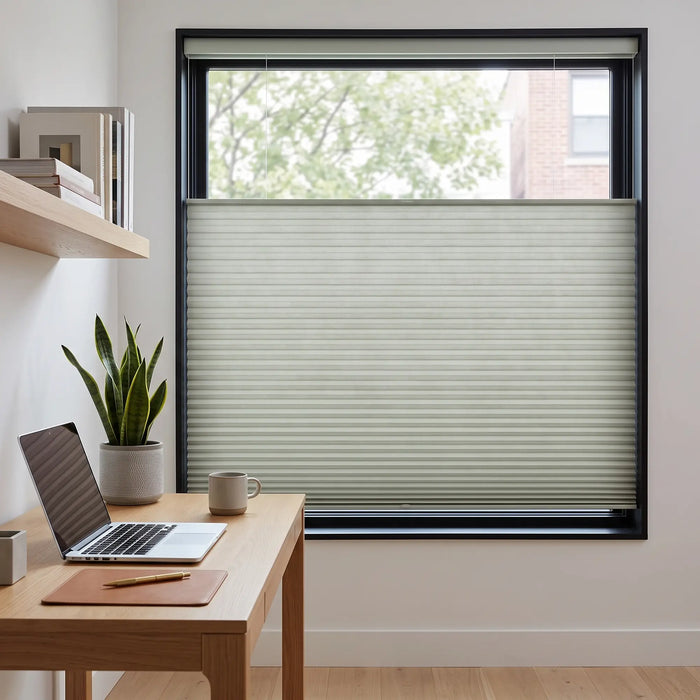
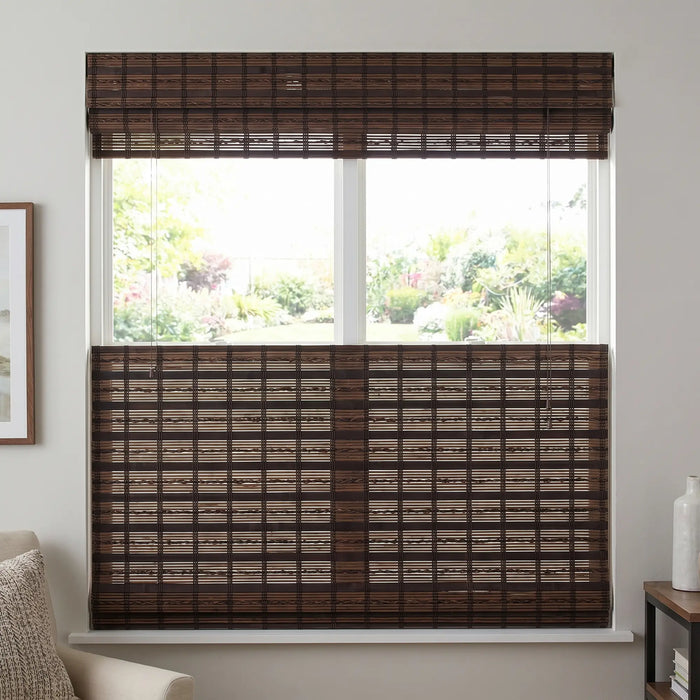
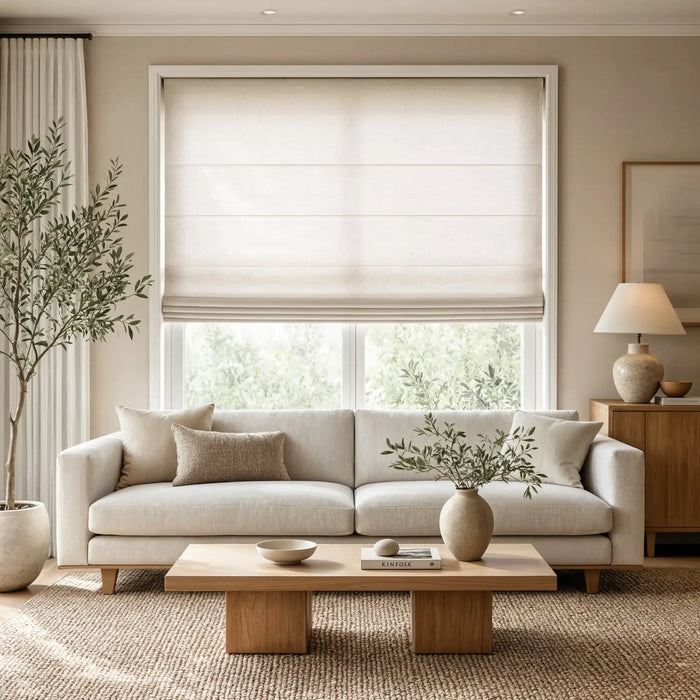
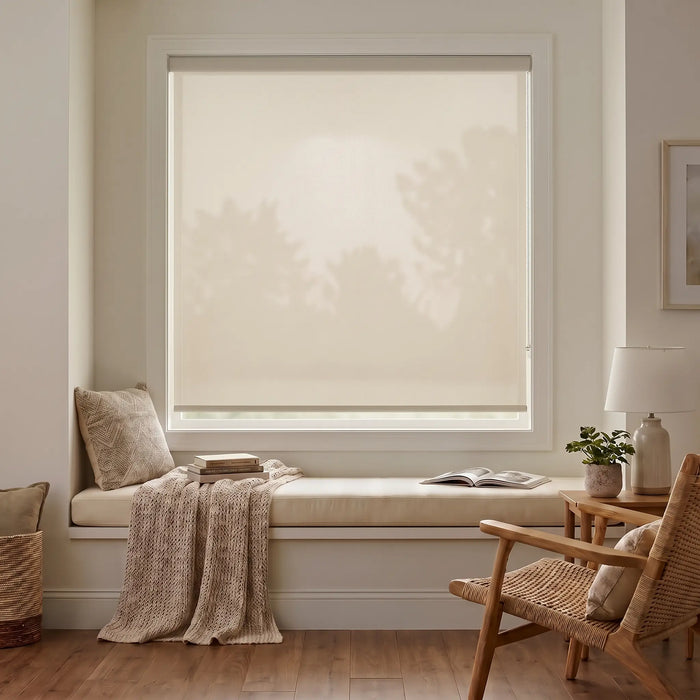
You will also see this sold as TDBU, up-down blinds or duofold. Same mechanism, and every shade here is cut to your exact opening.
The Four Positions You Will Actually Use
Fully closed is the baseline: both rails at the sill, maximum privacy and light control. Bottom-up is the conventional open position, fabric at the head, glass clear.
Top-down is the reason most people buy this style. Drop the upper rail by a third of the window and you get sky and borrowed daylight off the ceiling, while everything at seated eye level stays covered.
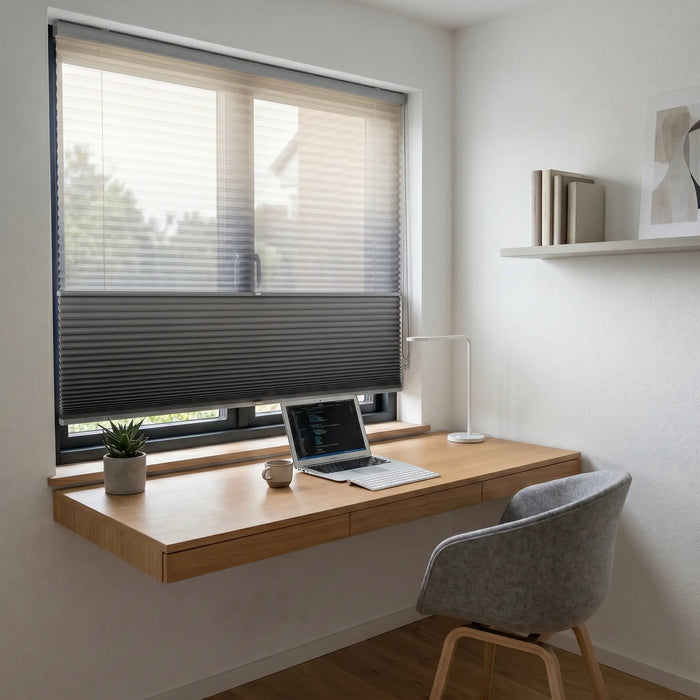
The fourth position is the one not many talk about, but we love: the floating band. Move both rails and you leave an open strip of glass at any height you choose. Set it at desk height to see the garden while you work, or low to watch the driveway while the top stays screened.
Which Shade Types Come as Top Down Bottom Up Shades
Cellular and honeycomb
Our most common two-rail construction. Honeycomb cells trap air, which gives the best insulation of any soft shade, and the compressed stack is small enough that two rails do not eat much glass. Single-cell is cordless. On double-cell, TDBU is a control style you pick inside the product, which alone also offers a corded clutch.
Go double-cell where heat is the real issue: one cell gives heat a single pocket to cross, a double gives it two plus the fabric between them. That buffer matters most on single-pane glass, older aluminum frames and drafty north-facing rooms.
Pleated shades
Flatter, single-layer, less expensive, also cordless. Pleated has crisper shadow lines and less bulk than honeycomb, but one layer gives modest insulation rather than the sealed two-layer performance of cellular. Pick pleated for a clean look, shallow frames and value; cellular for energy savings and noise reduction.
Woven wood cordless TDBU shades
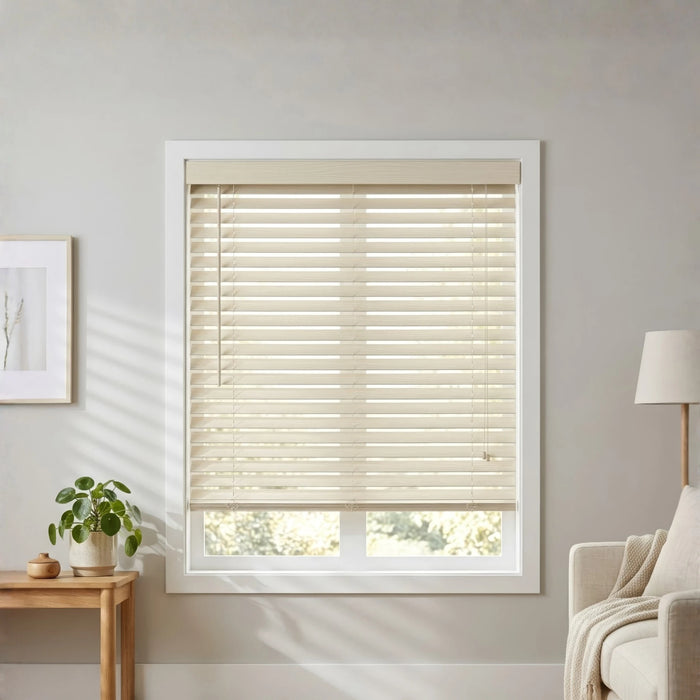
For natural material instead of fabric or honeycomb, our woven wood and bamboo shades include a cordless TDBU build. A balanced dual cordless system moves both rails, with a deeper, more textured stack than a compressed honeycomb.
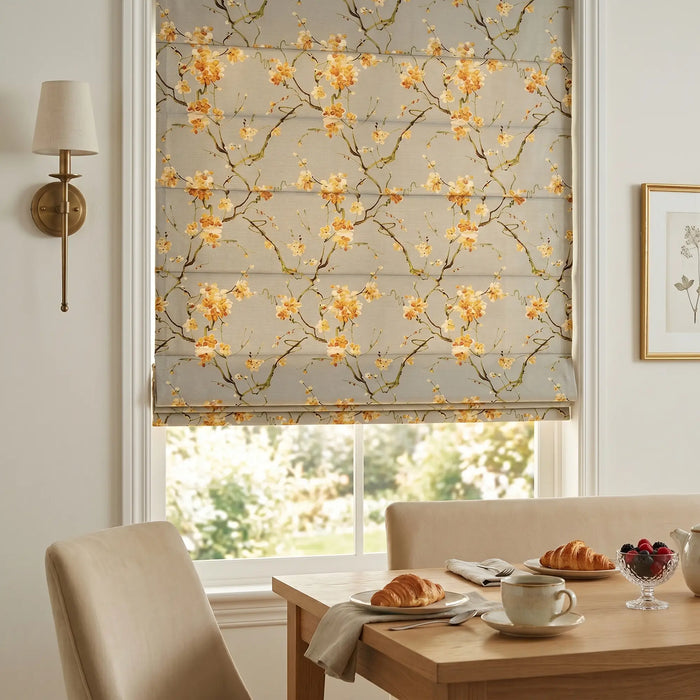
We do not build fabric Roman shades with two rails. If you want tailored folds, our Roman shades are single-rail only.
Room-darkening and blackout fabrics
Room-darkening and blackout fabrics are offered on much of the dual-rail range, though choices vary by product, so check the fabric list on your shade. Remember that darkening applies to the closed section only: drop the top rail and that band is open glass. For a fully dark room, keep both rails closed.
Rooms Where Up-Down Shades Solve a Real Problem
Street-facing living rooms are the classic case. A ground-floor window on a sidewalk gives you daylight with full exposure, or privacy and a cave. Two rails give both. Bathrooms work the same way: the open band sits above outside sightlines. In a nursery, keep the lower two-thirds closed for a nap and crack the top a hand span.
In a home office, low winter sun comes in below eye level and lands on the monitor, so raise the bottom rail and leave the top open. Ground-floor bedrooms, kitchen windows facing a driveway and half-height basement windows round out the list.
Controls: Cordless, and a Clutch on Double-Cell
Cordless is the standard on almost every TDBU shade we sell. Each rail has a grab handle and holds position anywhere in the travel, with no cord loop, which is right for a child's room. See our full cordless range.
Our double-cell cellular line adds one alternative: a Clutch TDBU control, a continuous-loop corded mechanism. It earns its place on tall windows: you move the rails from the loop instead of reaching a rail. Specific to that line only.
We do not offer motorization on a two-rail shade. If reach on a tall window matters more than the daylight split, our motorized shades are single-rail, and may be the better trade.
The trade-off nobody tells you upfront, but we do.
A two-rail build costs more than the same fabric in a single-rail shade. The surcharge is real and sometimes significant, but it is not a flat percentage: a modest bump on some budget and blackout shades, much larger on premium lines, a set dollar add-on on our double-cell line. Check the price on the exact product and size you want.
There is also a stack penalty. Drop the upper rail and the compressed fabric sits right beneath it, so part of the opened band is stack, not clear glass. Under about three feet of window height, that eats a real share of the view.
Two rails means two things to keep level — a shade racked out of square shows the fault twice. It also stacks vertically, so for a patio slider or wide glass wall, look at vertical blinds instead.
Measuring, Mounting and Upkeep
Measure width at the top, middle and bottom, and height at the left, center and right; use the narrowest width and the longest height. For an inside mount, give us the raw opening size and we take the deduction.
Depth depends on the product and control style. Pleated needs as little as about 1 1/16 inches of flat reveal, cellular with a cordless lift wants 2 1/4 inches or more, and a valance or the clutch adds more again. Check the spec on your shade before ordering. The bottom rail on a two-rail build projects a fraction more than a single-rail equivalent, so watch for cranks and handles it might foul.
For an outside mount, add roughly two inches of overlap per side and two inches top and bottom. Height accuracy matters, because the stack stays visible instead of parking out of sight. Removing an old treatment first? Our guide to removing blinds, Venetian, Roman and more shows how each bracket releases.
For upkeep, vacuum on low suction with a brush, along the pleats. On honeycomb, a cool hair dryer or a burst of compressed air clears the inside of the cells, where dust collects. Spot-clean with a damp cloth and mild soap, and never soak a cellular panel: water wicks along the cells and dries with a tide line. If the shade goes crooked, lower it fully, level the rail by hand and raise it slowly.
 Skip to content