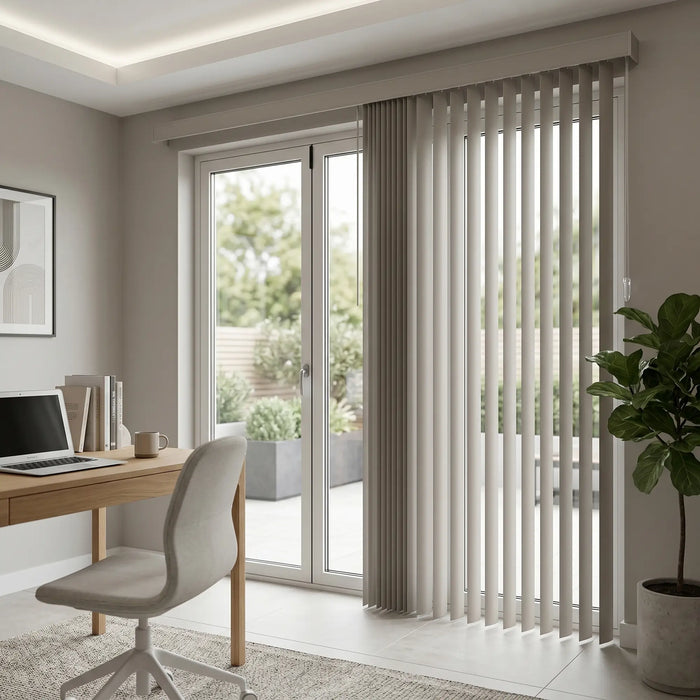
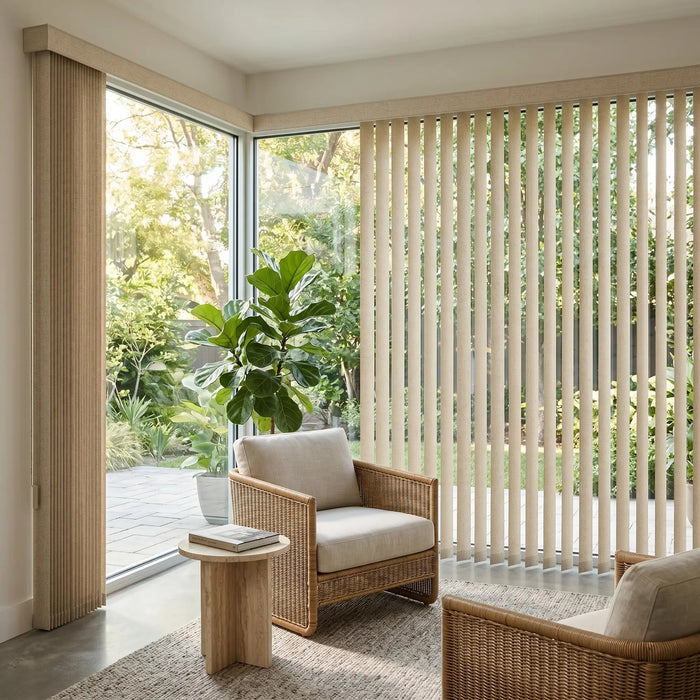
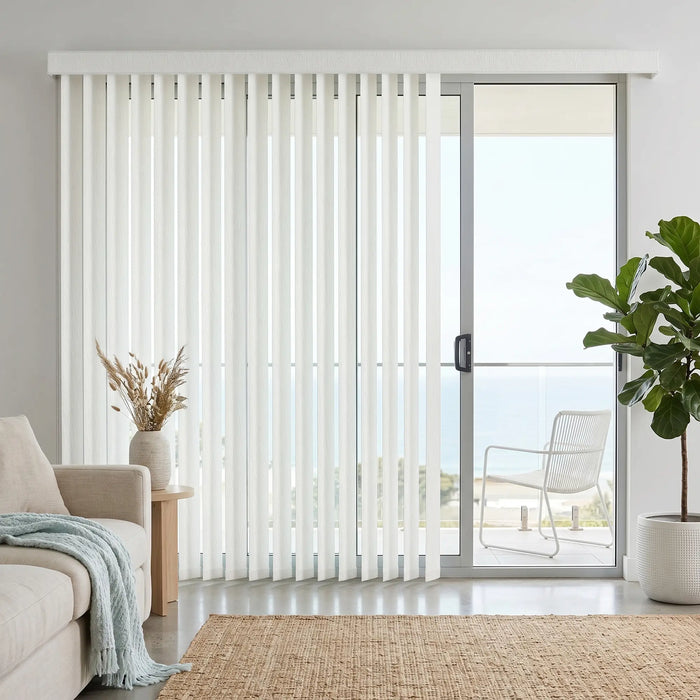
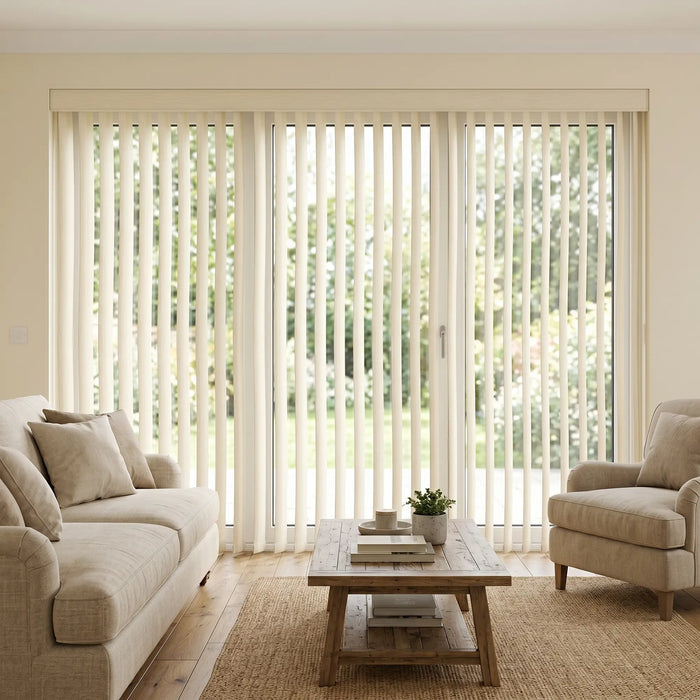
Sliding glass doors defeat most window treatments. They are wide, they are tall, and you walk through them constantly – and a horizontal blind has to be raised every time you step outside, which can get frustrating very quickly. Verticals are built around that reality: the vanes draw cleanly to one side, so you push through and step out without fighting anything. And because rotation is independent of how far the vanes are drawn, you can leave the door fully covered and simply tilt for light and airflow.
Size is the other half of the decision for vertical blinds. We build to sixteen feet wide and twelve feet tall on one continuous headrail, so most patio doors can be fitted with a single tailored treatment rather than a row of multiple blinds. The same holds on wide windows with no door in them: past the width where a horizontal blind becomes a two-handed job, a vertical has no such problem, because nothing is being lifted.
You will find the whole sliding glass door range grouped together, and verticals make up most of it.
Stack Direction: The Choice That Matters Most
Stack direction means which way the vanes gather when you draw them open, and it is the single decision people most often get wrong.
Left stack or right stack sends every vane to one side. On a door, choose the side opposite the way the door itself slides open, so the stack never sits in the doorway you are trying to walk through. Get this backwards and you will be pushing past a bundle of vanes every time you go outside – the blind will work perfectly and you will still hate it.
Split stack parts the vanes in the middle and sends half each way, with the controls on your choice of left or right. That suits a centred window, a French-door pair, or a wide expanse of glass where a single stack would pile up too deep at one end. It is usually the wrong call on a single-panel slider, because it leaves half the stack in front of the moving door.
Worth checking before you decide: stand in the room, open the door, and note which end you actually walk past. That is the end the stack should not be on.
Vane Materials and Styles
All seven builds use a 3½-inch vane. What changes is the material and the profile.
- Smooth PVC is the workhorse: opaque, wipe-clean, and the least expensive way to cover a large opening properly. Our Classic Curved vane adds a gentle bow across its width, which catches light along the curve instead of reading as a flat institutional panel.
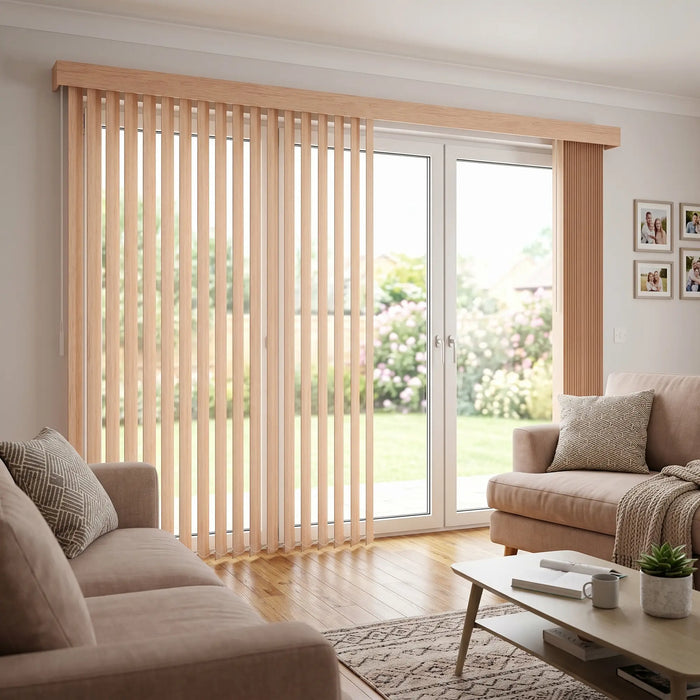
- Faux woodgrain PVC comes in a smooth finish and a textured finish. Both give the warmth of timber on a door where real wood would be impossibly heavy, and the textured version carries an embossed grain that breaks up the surface at close range. If the rest of the room already uses faux wood blinds, this is how the slider matches them.
- S-shape vanes curve more deeply, so neighbouring vanes nest into one another when closed. That overlap closes the gaps more tightly than a flat vane and gives noticeably better light control and privacy – the upgrade to make if the door faces something you would rather not see.
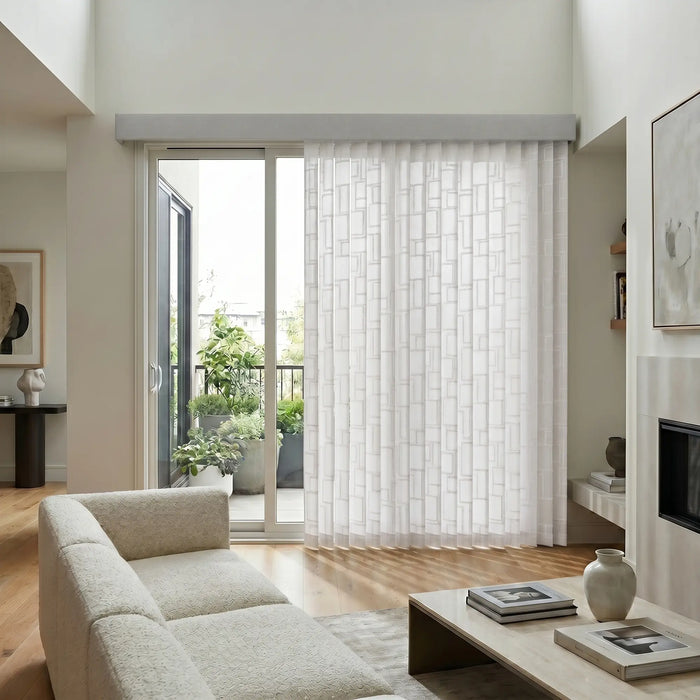
- Fabric vanes are the top of the range and the biggest departure in look. Genuine light filtering fabric hangs with the weight and movement of a drapery panel, diffusing daylight into a warm glow rather than blocking it. They can hang free, or sit in a rigid white channel that holds each vane dead straight – free hang is softer, the channel crisper.
Every build also takes an optional square corner valance to conceal the head track, and a set of three extra vanes for denser coverage when closed.
Light, Privacy and the Gaps Between Vanes
PVC vanes are opaque. Rotate them fully closed and they block the great majority of incoming light and give solid privacy, day and night.
What no vertical blind does is seal. Because the vanes hang side by side rather than meeting a frame, thin lines of light show between them and at the edges of the opening. That is true of every vertical blind ever made, ours included, and worth knowing before you order rather than after. Two things tighten it up: rotating the vanes fully closed rather than nearly closed, which people often do not, and adding the extra vanes for denser overlap. The S-shape profile helps for the same reason.
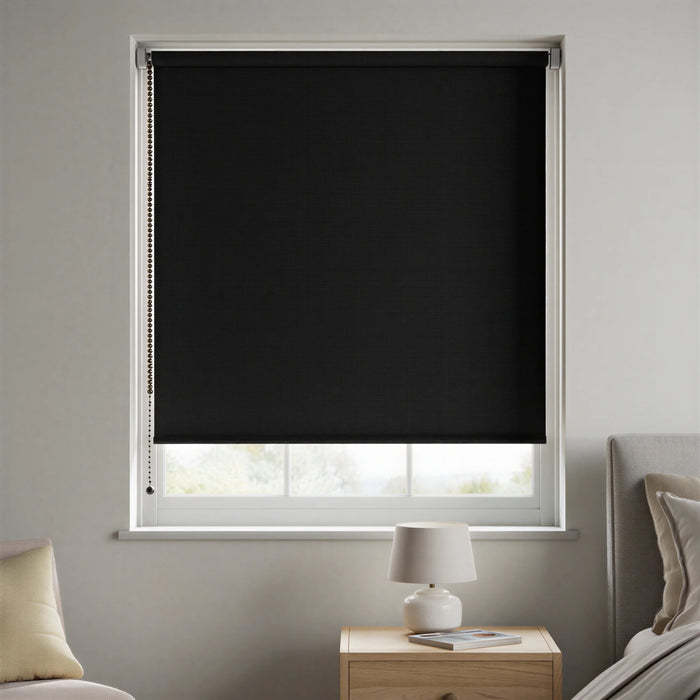
If what you need is genuine darkness – a bedroom, a media room, a nursery – a vertical is the wrong tool and a blackout shade mounted outside the frame is the right one. There is no blackout vane in this range, and a fabric vane filters light by design rather than stopping it.
Wand Control, No Cords
Every vertical we build is wand operated. One wand rotates the vanes and draws them along the track, and there is no lift cord anywhere on the blind – nothing looped, nothing hanging, nothing within reach of a child or a pet. It also suits the product: a sixteen-foot run of vanes wants a rigid wand, which will not tangle behind furniture the way a chain does.
The vanes themselves are made from non-toxic, lead-free, fire-retardant material.
Measuring, Mounting and Care
An inside mount sits the head track inside the opening for a recessed, built-in look. An outside mount fixes above and beyond the opening, covers the frame entirely and hides any part of the door surround you would rather not look at. Both are standard here, and on a door an outside mount is often the better choice simply because it lets the stack sit clear of the glass when drawn.
Measure the opening rather than an existing blind, take the width in three places and the height in three, and give us the raw opening figure – we apply the deduction. We publish a vertical blind measuring guide and a separate installation guide that walk through the track and the carriers step by step.
For care, vanes wipe down with a damp cloth and mild soap – one of the genuine advantages of a PVC vane over any fabric treatment. Individual vanes unclip from their carriers, so you can take one down to clean it properly rather than working at arm's length. Fabric vanes should be vacuumed on low suction and spot-cleaned only.
Order free samples to see the vane material against your own floor and trim before committing to a whole door. Every blind is built to your measurements, so production runs about five to seven business days, shipping is free within the continental United States, and you can add the MeasureSafe™ Guarantee at checkout: measure wrong and we remake the blind.
 Skip to content