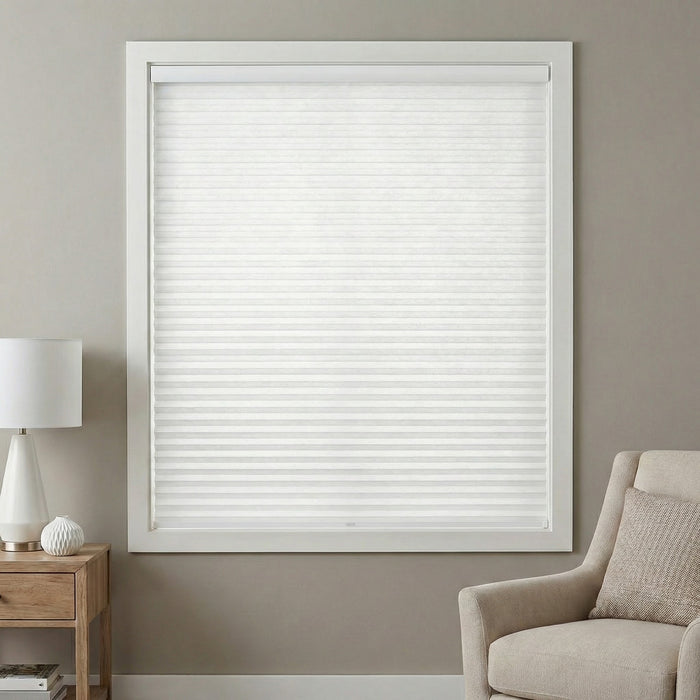
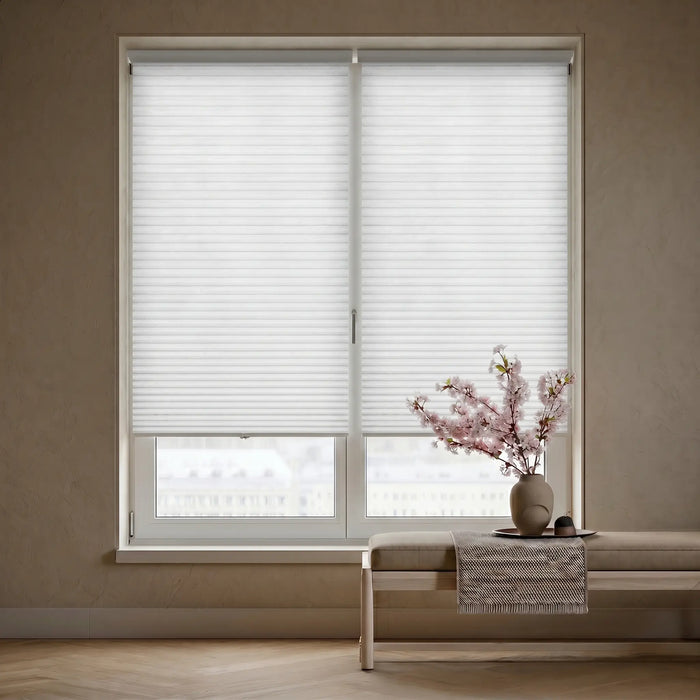
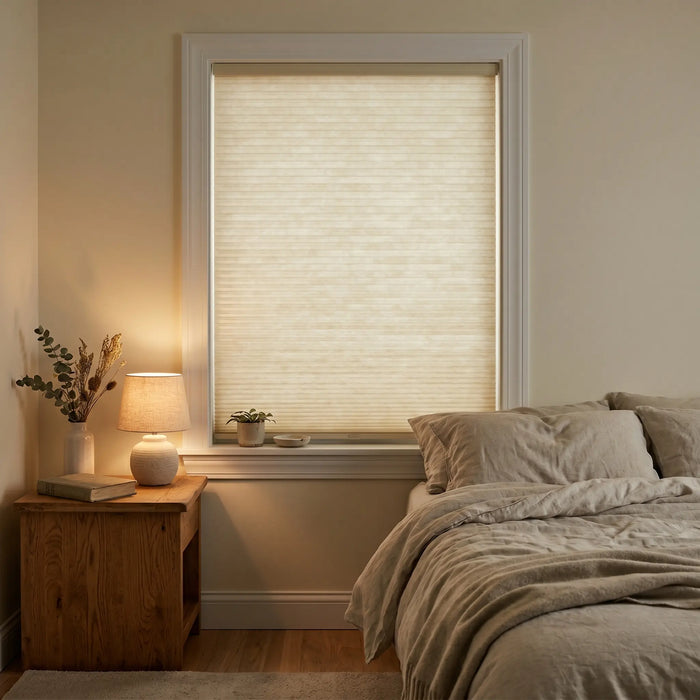
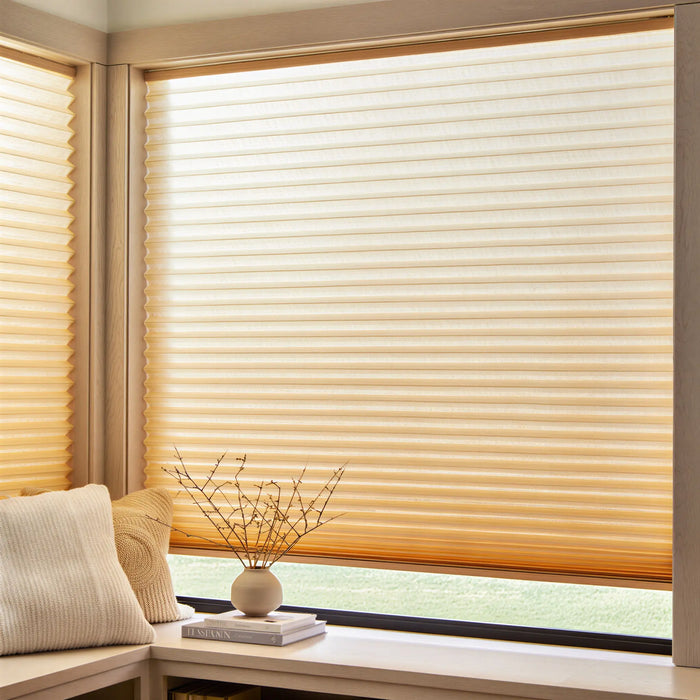
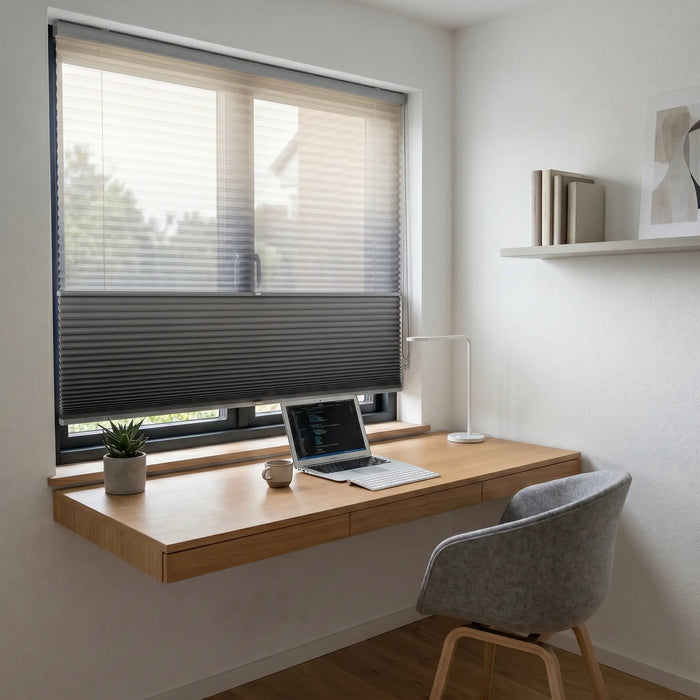
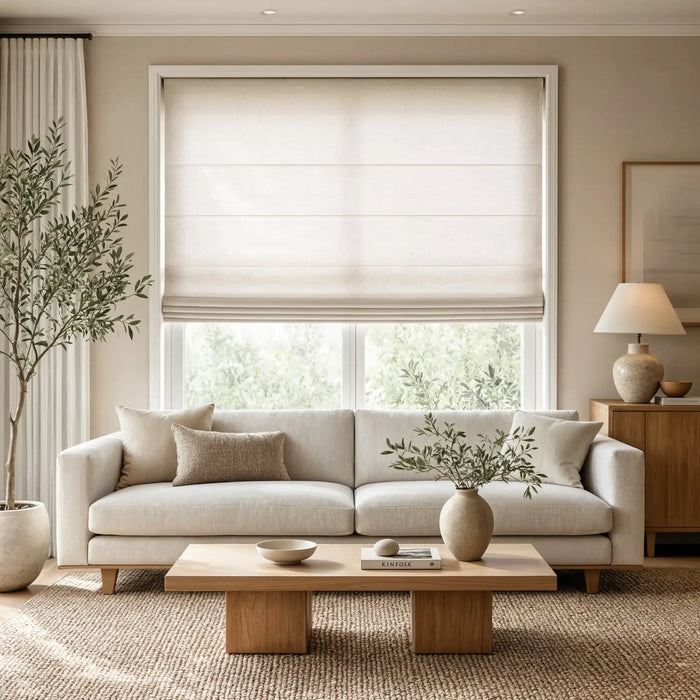
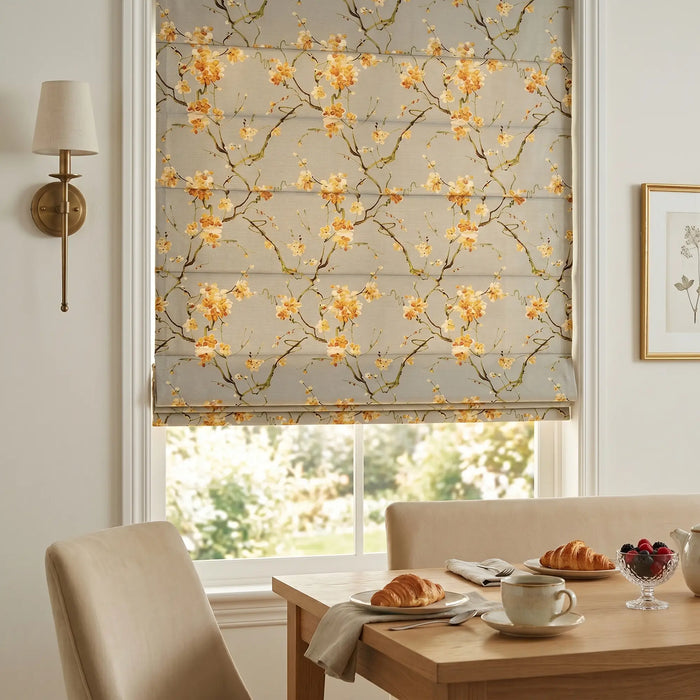
The fold is the whole design. The fabric carries a finish that holds the crease, and thin lift cords run through the pleats to a slim headrail, which is why the shade stacks so tightly and sits so shallow in the window. There is no tilt and no slat, which puts it firmly in the window shades family rather than the blinds one. The fabric decides how much light comes through, and you raise or lower it to decide how much window is covered.
Pleated or Cellular?
The two look almost identical across a room, and the difference is inside the fold.
A pleated shade is a single folded layer of fabric. A cellular shade joins two layers so the pleats form sealed honeycomb cells, and those cells hold a pocket of still air against the glass. That trapped air is what makes cellular the better insulator. A pleated shade insulates modestly, from the fabric alone.
What pleated gives you back is profile and price. The stack is slimmer, the mount depth is shallower, and the shade costs less for the same window. So the honest split is this: if cutting an energy bill or damping noise is the job, buy cellular. If you want the clean pleated look in a window where insulation is not the point, this is the range, and you are not paying for a performance layer you do not need.
The Two Ranges
Both are cordless, both use the same construction, and they differ in fabric and color.
- Classic comes in Powder, Tusk, Slate, and Sable, ending in a warm brown that suits wood trim and darker rooms.
- Simplistic comes in Feather, Crepe, Moccasin and Smoke, a quieter set of neutrals for painted trim and lighter walls.
Order free samples before you choose. Fabric color reads differently against your own wall and in your own daylight than it does on a screen, and with eight shades across two ranges, it is worth checking in your space to be sure.
Light and Privacy: What They Do, and What They Do Not
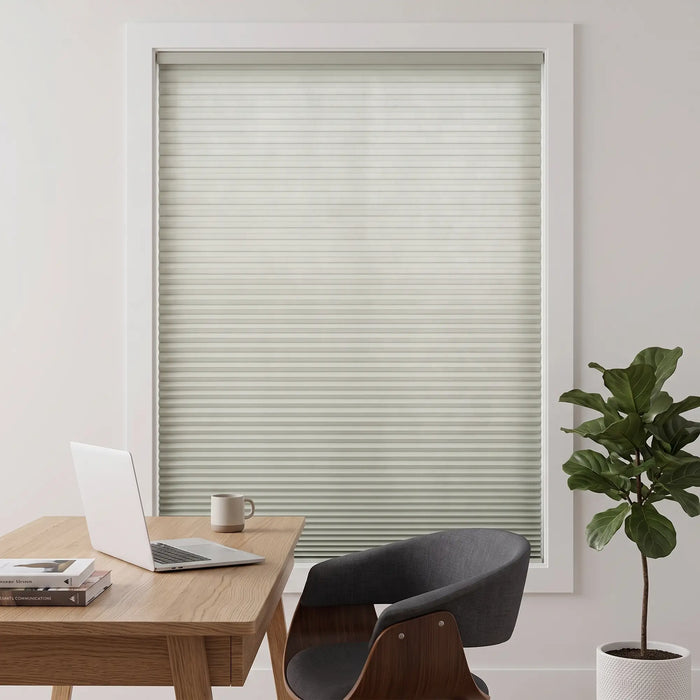
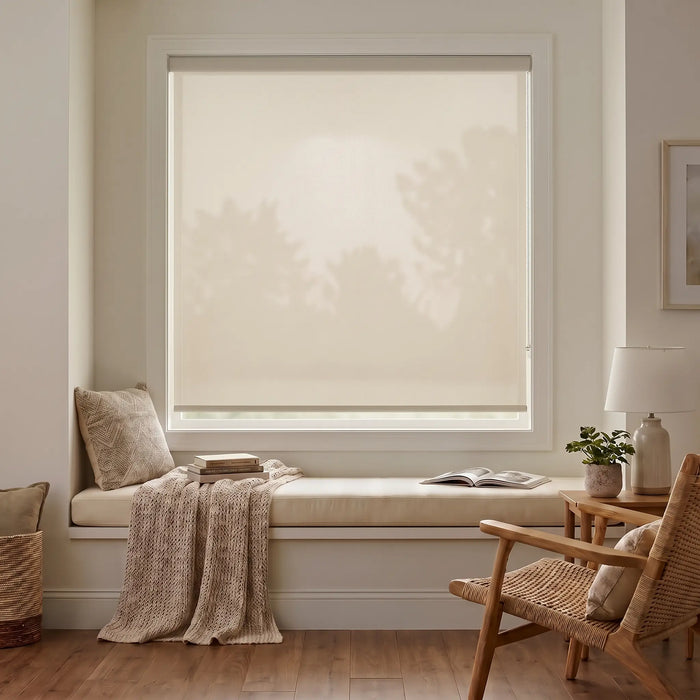
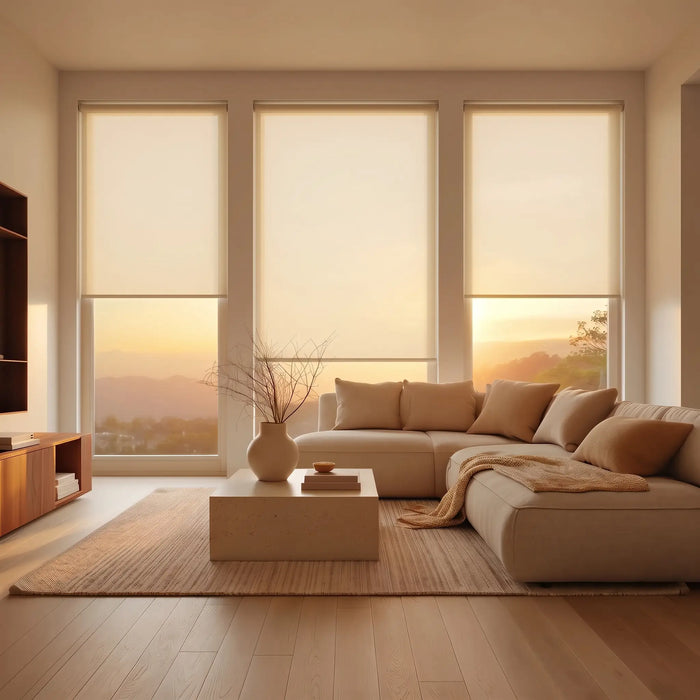
All of our pleated shades are light filtering. The fabric softens hard sun into an even glow and obscures the view in during daylight, so a street-facing living room or a home office gets privacy without going dim.
What it will not do is make a room dark. These are not blackout shades, and once your lamps are on after dark, silhouettes may be visible from outside. If you are covering a bedroom or a nursery, or any window where you need real darkness, a blackout shade is the right product.
For a window where filtered daylight is the goal, the pleat does something a flat panel cannot: the folds catch light along their edges, so the face has depth and texture rather than reading as one blank sheet.
Cordless Lift and the Top-Down Option
Every pleated shade we offer is cordless. You raise it by the bottom rail, and it holds where you leave it, with no looped cord anywhere on the window. This is best for homes with children or pets, and it is the approach we take for the cordless range across our catalog.
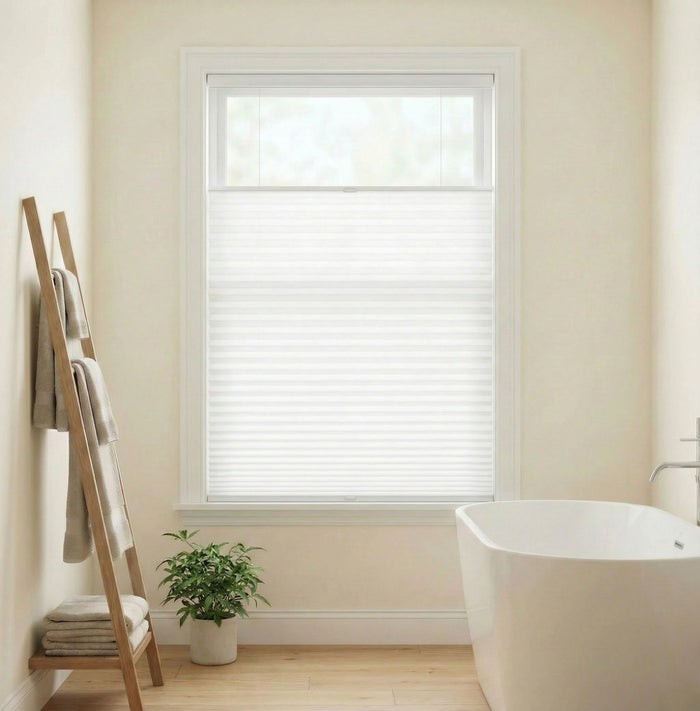
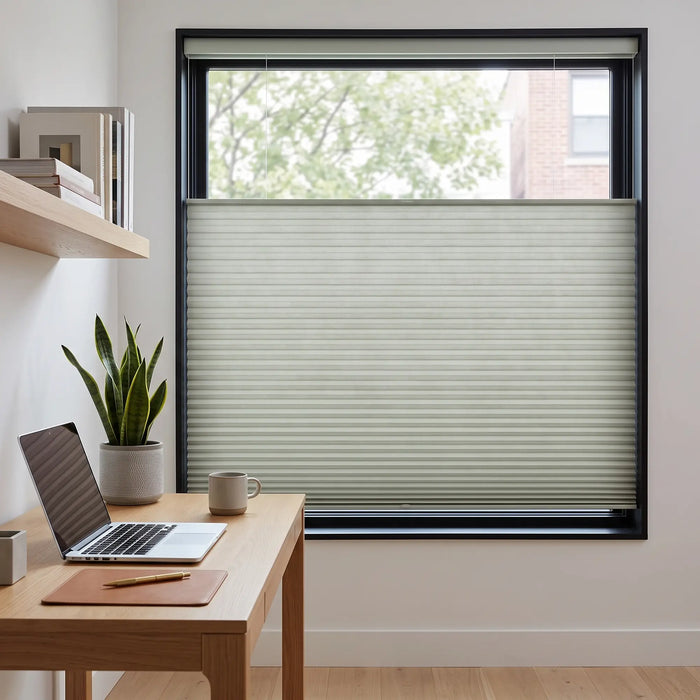
We also offer top-down/bottom-up shades, with a second moving rail. Drop the top for daylight and a view of the sky while the bottom stays shut at eye level, which is what a ground-floor window facing a sidewalk usually needs.
The two-rail build asks a little more of the window. It needs a deeper headrail, a slightly taller stack, and about half an inch more mounting depth than the standard shade.
Where Pleated Shades Fit
The standout spec is depth. A standard pleated shade needs as little as 1 1/16 inches of flat reveal for an inside mount, which is the shallowest requirement in our range. Shallow modern frames, bullnose drywall returns and windows with a crank or handle in the way will often take a pleated shade when nothing else will fit inside the opening.
The stack is the other advantage. Raised, the shade gathers into roughly two and a half to four inches at the head of the window depending on the drop, so it parks out of the way and leaves the glass clear.
Beyond that, the fit is about the job:
- Home offices and living rooms: daytime privacy and diffused light without losing the room's brightness. See the full office range.
- Kitchens, laundries and hallways: windows that need covering neatly and cheaply rather than sealing. Over a sink or a tub, a wipe-clean roller shade handles moisture better.
- Rentals and whole-house projects: the lowest cost per window in our soft shades, which matters when you are doing eight of them at once.
- Second and third bedrooms: fine where the room is used in daylight, not where someone sleeps late.
- Shallow or obstructed openings: where the 1 1/16 inch mount depth is the reason the shade fits at all.
Measuring, Mounting and Care
We build from 18 to 72 inches wide and 24 to 84 inches high. Measure the opening in three places for width and three for height, use the narrowest width and the longest height, and give us the raw opening figure rather than deducting anything yourself. We apply the deduction. Our measuring guide covers the process for inside and outside mounts.
For an outside mount, add about two inches of overlap on each side and two inches above and below the opening, which keeps light off the edges and hides the stack. Outside mounts have no depth requirement at all, so a reveal too shallow even for a pleated shade is not the end of it.
For care, dust the face with a vacuum brush on low suction, working along the pleats rather than across them. Spot-clean sparingly with a barely damp cloth and let the shade dry fully in the lowered position. Do not soak or machine wash a pleated shade: the fabric's stiffening finish is what holds the crease, and water strips it, which is how a crisp shade turns into a limp one.
Each shade is built to order at your measurements, so production takes about five to seven business days. Shipping is free within the continental United States, and you can add the MeasureSafe™ Guarantee if you need extra peace of mind.
 Skip to content