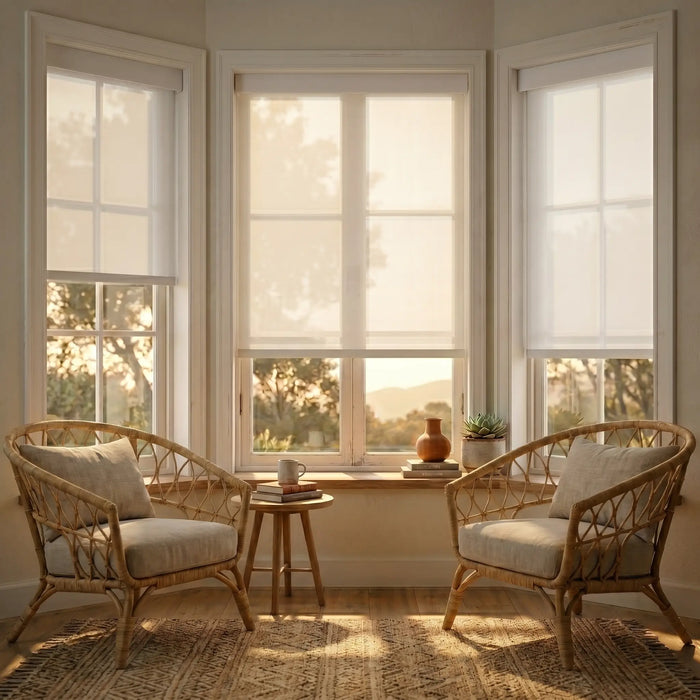
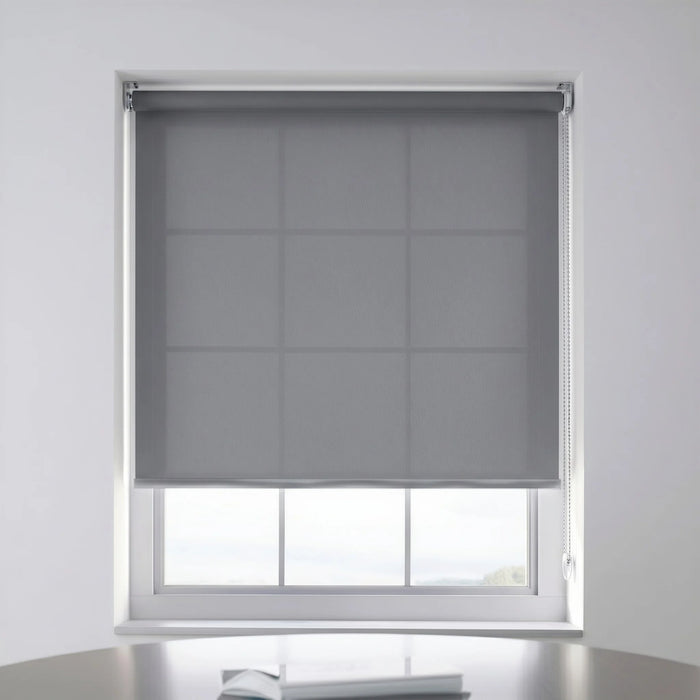
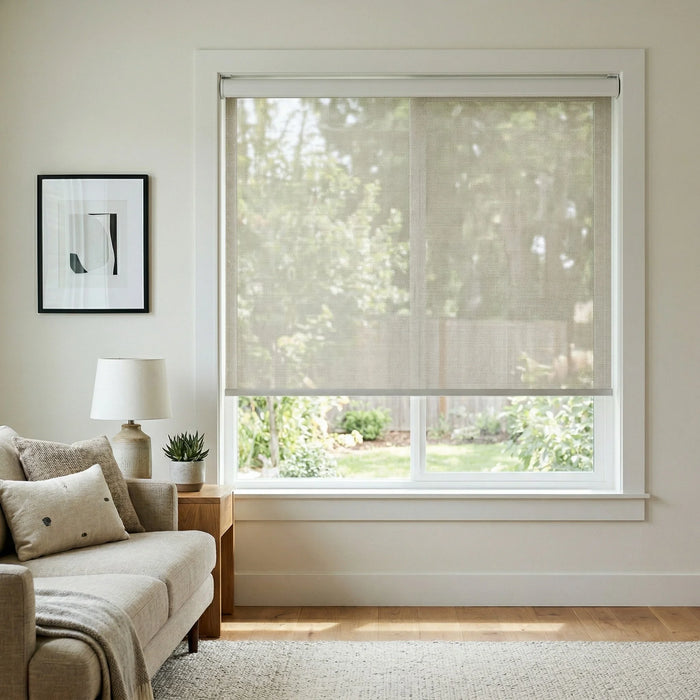
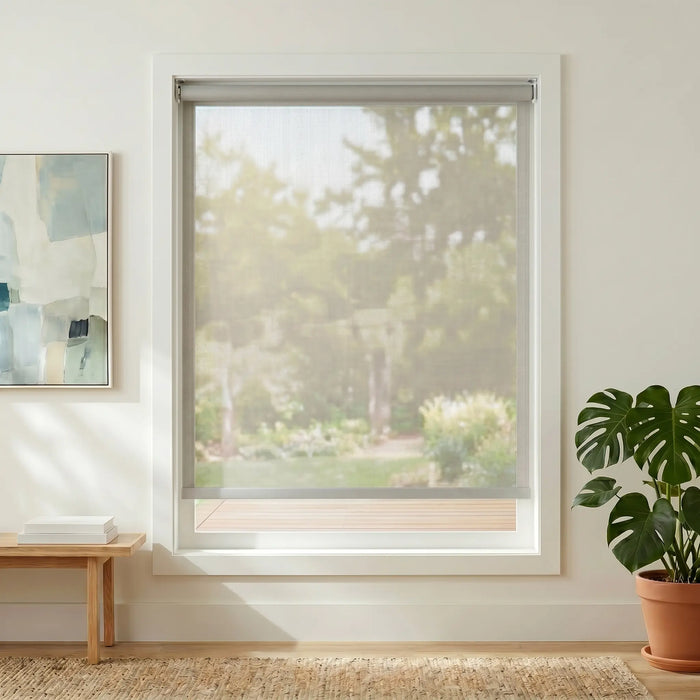
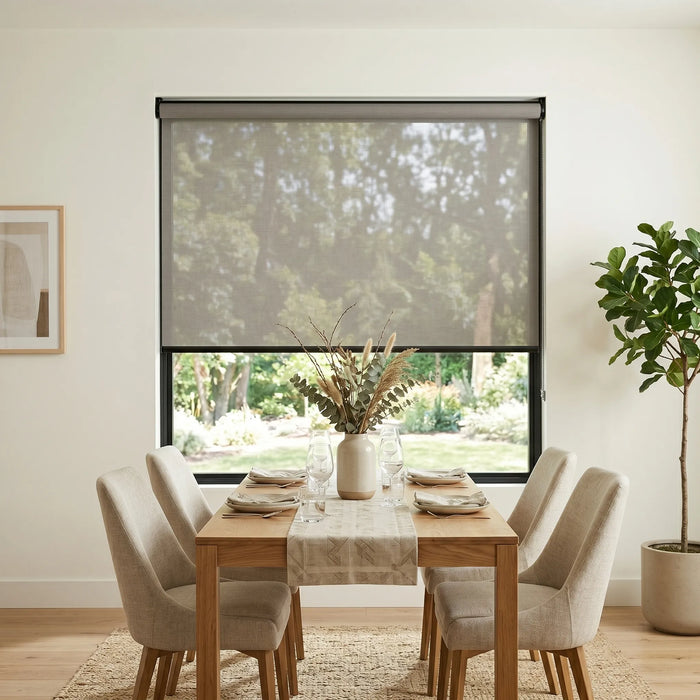
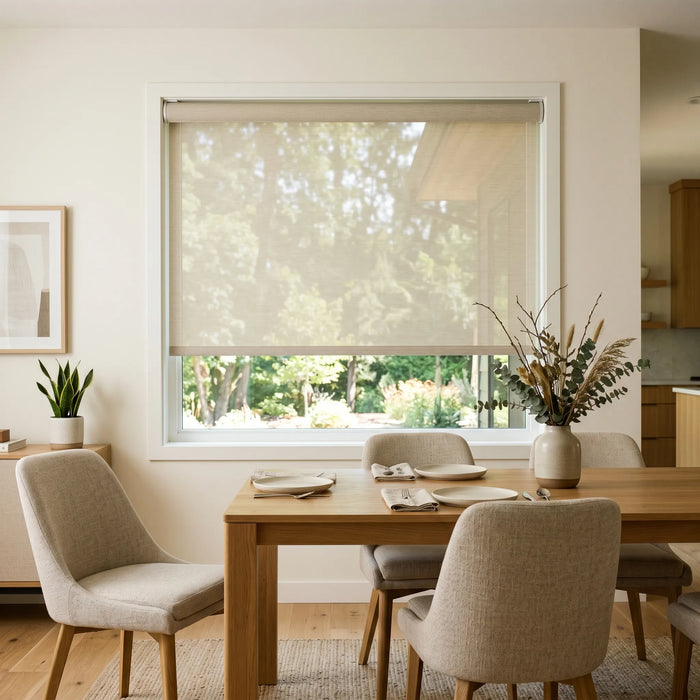
That trade is set by one number: openness. A tighter weave stops more sun and shows less view; a more open weave keeps the view sharp and lets more light and air through. Everything else follows from that choice.
Ours are a PVC and polyester solar mesh, chosen for colour fastness and resistance to fading and moisture. Mechanically they are roller shades, so the same fabric works as well on a west-facing living room window as on a porch.
Where These Shades Belong
Worth being straight about this, because it decides whether you are happy in year three.
These are built for covered and enclosed spaces. A screened porch, a sunroom, a three-season room, a patio with a roof or a solid pergola above it, a lanai. In those places the shade is doing real work – cutting the afternoon sun that makes the space unusable – while the structure above keeps weather off the roller, the brackets and the motor.
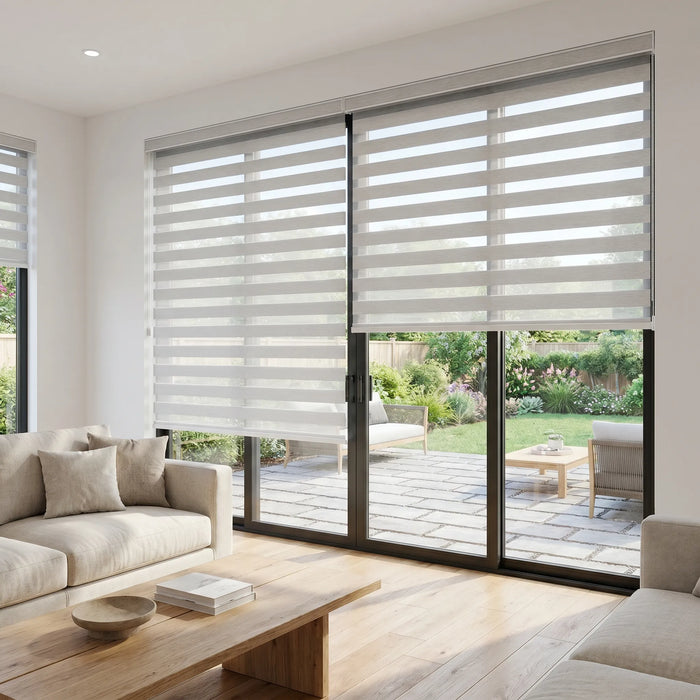
They are also excellent on sun-facing windows anywhere in the house, including a sliding glass door that bakes in the afternoon. The mesh keeps the view a blackout fabric would take away.
What they are not is a weather-exposed product. There is no wind rating, no side track and no tie-down system in this range, so we do not recommend hanging one in the open with nothing above it. If your patio has no cover at all, a vertical shade is not really the answer anyway – nothing that hangs at the side will shade a space whose sun comes from overhead. Build the cover first, then shade the sides.
For a screened porch specifically, we group everything that suits one in a porch collection.
Choosing an Openness Level
We build five, and the percentage is simply how much of the weave is left open.
- 1 percent – the tightest weave we make. Blocks 99 percent of UV, gives the strongest daytime privacy and the best glare control. This is the one for a west or south-facing opening that takes the full brunt of the afternoon.
- 3 percent – blocks 97 percent of UV, with high daytime privacy and excellent glare control.
- 5 percent – blocks 95 percent of UV. Moderate privacy and a softened view out. The middle of the range and the usual safe choice.
- 10 percent – blocks 90 percent of UV with strong glare control and clearly better visibility. Right where the view matters more than privacy, such as a porch facing your own garden.
- 14 percent – blocks 86 percent of UV and keeps the sharpest view and the brightest, airiest feel of the five.
Colour matters as much as openness, and not in the way most people expect. Darker fabrics give the best glare control and the sharpest view out, because the mesh is not bouncing light back at your eye. Lighter fabrics reflect more heat away from the opening. So a charcoal 5 percent and an ivory 5 percent behave quite differently, and the choice depends on whether you are fighting glare or heat.
Each openness level comes in six to eight colours. Order free samples before deciding – mesh reads completely differently with sun behind it than it does on a screen.
Privacy, Heat and What the Mesh Will Not Do
During daylight, a solar mesh works on a brightness difference. Outside is brighter than inside, so you see out and nobody sees in. The tighter the weave, the stronger that effect.
After dark it reverses. Once lights are on in the space behind the shade, that space becomes the bright side and shapes are visible from outside. This is true of every solar screen, at every openness, and no percentage fixes it. If a porch is used in the evening and you want it private, plan on a second layer or a solid shade rather than a tighter mesh.
On heat, the mesh stops a large share of the solar energy before it reaches you, which is what makes a covered patio usable again on an August afternoon. It is shade, not insulation – it will not hold warmth in during winter the way a cellular shade does on an interior window.
The weave also cuts windblown dust and leaves reaching the space, but it is not a screen. It will not keep insects out, and it is not a substitute for porch screening.
Size, Lift and Motorization
A single shade covers a genuinely wide opening. On chain control we build up to 115 inches wide and 108 inches high, which handles most porch bays between posts without splitting the opening.
Cordless lift suits smaller openings, up to 84 inches either way: raise the shade by the bottom rail and it holds where you leave it, with no chain hanging anywhere. A bead chain over a clutch, in plastic or metal, is the standard on everything wider and gives a large mesh panel the mechanical advantage it needs.
Motorized lift is where these earn their keep on a porch, and runs to 96 inches wide and 108 inches high. A porch shade is usually high up and often behind furniture, and the one you have to reach across a table to lower is the one you stop using. Remote channels let a run of shades move together, and you can raise them from indoors when the weather turns.
You can also pick a standard or reverse roll, and add a cassette valance that closes the top of the roll rather than leaving the tube open.
Measuring, Mounting and Care
Measure the opening in three places for width and three for height, work from the narrowest width and the longest height, and give us the raw opening figure. We take the deduction. Our measuring guide covers the process.
An inside mount needs about two and a half inches of flat depth, a little more with a cassette valance or for a fully recessed fit. An outside mount has no depth requirement at all, which is usually the answer on a porch opening or a frame too shallow to take the roller. If your opening is not a standard window – a bay between porch posts, an irregular frame – send us the dimensions before you order and we will tell you what will fit.
For care, wipe the mesh with a non-abrasive sponge or cloth, light soap and water. Let the fabric dry completely before rolling it up, because rolling a damp shade traps moisture in the roll. Nothing abrasive and no solvents.
Every shade is built to your measurements, so production runs about five to seven business days and shipping is free within the continental United States. You can add the MeasureSafe™ Guarantee at checkout: measure wrong and we remake the shade.
 Skip to content


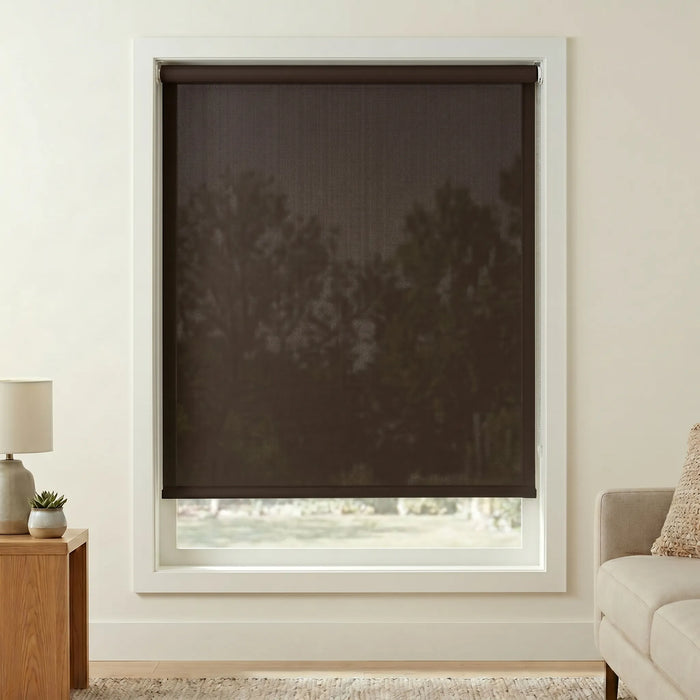 7 colors available(237)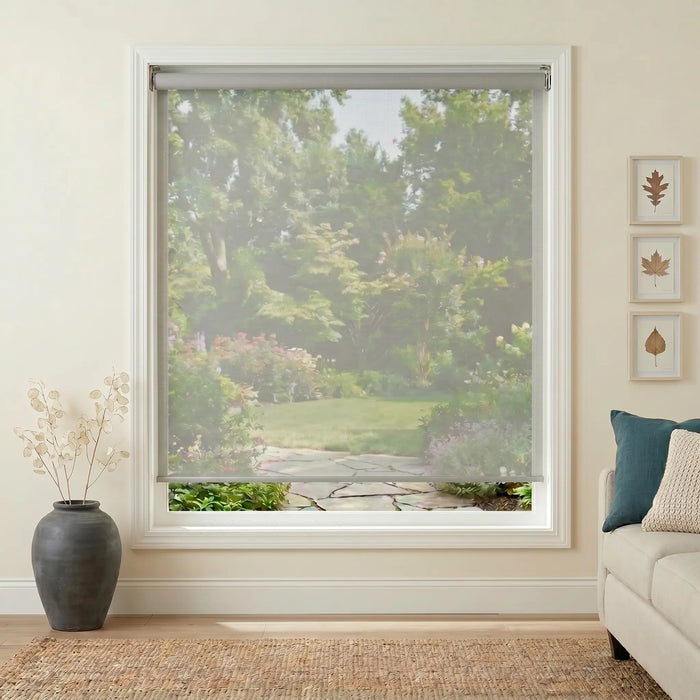
 6 colors available(233)