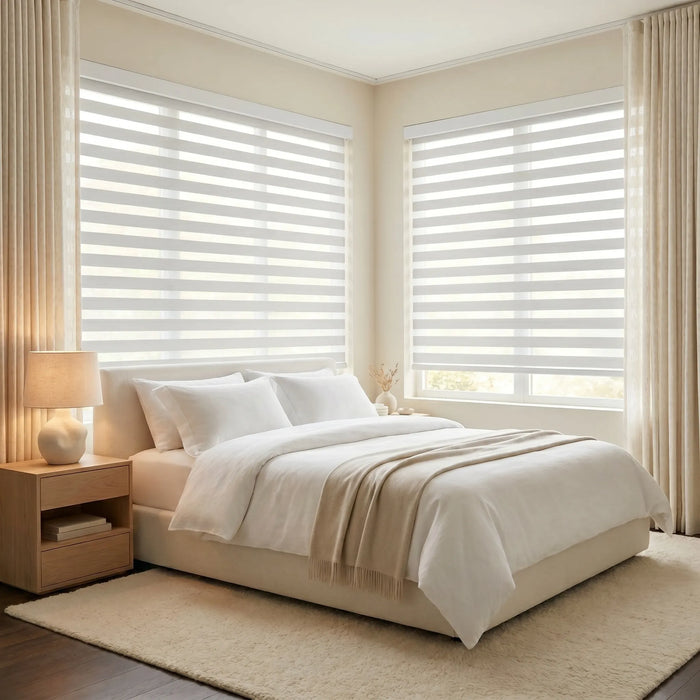
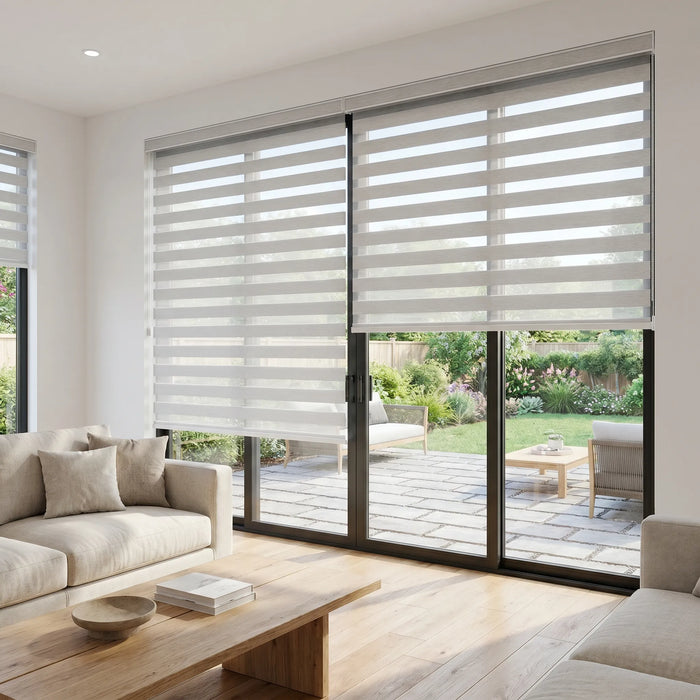
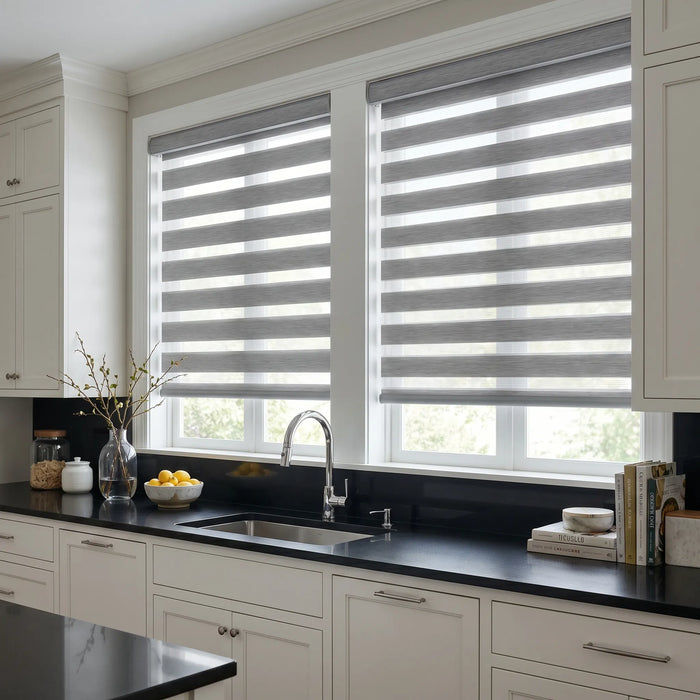
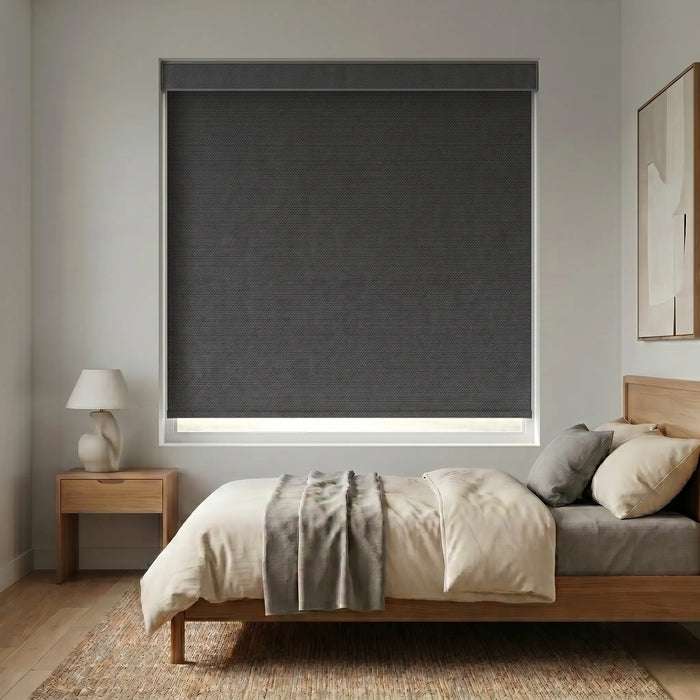
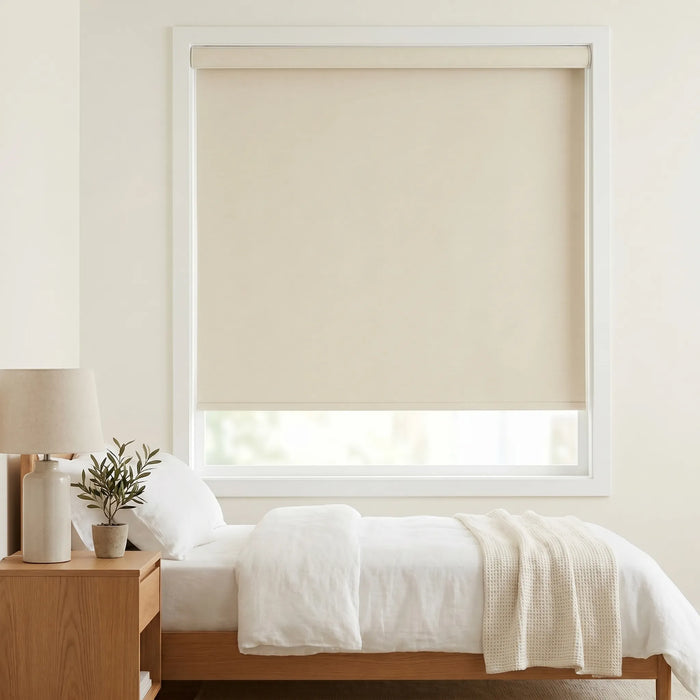
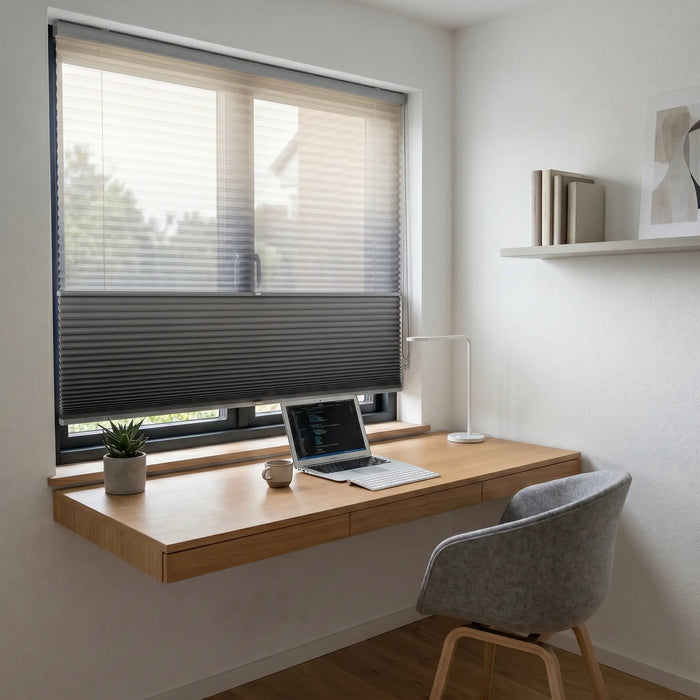
- Aligned, or open. The sheer bands line up with each other. Filtered daylight comes through and you get a softened view out, roughly the effect of a wood blind with its slats tilted open.
- Offset, or closed. The solid bands move across to cover the sheer ones. The face reads as one continuous panel, and privacy goes up sharply.
- Partially raised. You can raise the shade to any height and keep the bands in either position, so you might clear the bottom third of the window for light while leaving the top in the closed position against a low sun.
The primary appeal of zebra shades is adjusting light and privacy without raising the shade at all, which a plain roller shade cannot do.
The bands work the same way in all three. What changes is what the solid band is made of.
Light filtering pairs sheer bands with semi-opaque bands, in thirteen colours – the widest choice of the three. Closed, it gives high daytime privacy and a soft diffused glow rather than darkness. This is the default for living rooms, dining rooms and kitchens.
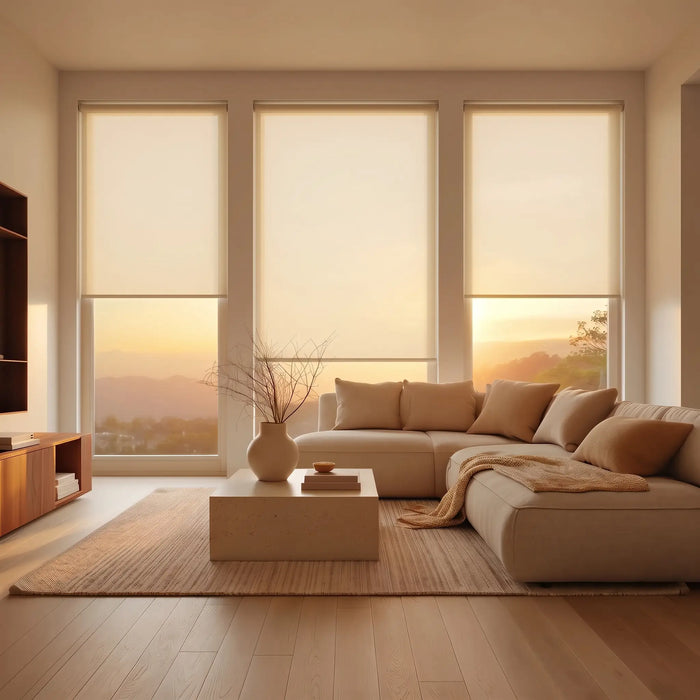
Solar swaps the solid band for a 5 percent open solar weave in six colours. Closed, it still passes some light and view, but it cuts UV, heat and glare the way a solar shade does. Choose it for a west-facing wall of glass or an office full of screens, where glare matters more than privacy.
Room darkening uses a genuinely opaque band in nine colours. Closed, it blocks the great majority of light and gives the strongest privacy of the three. This is the one for bedrooms, media rooms and street-facing windows.
If you are unsure, order free samples. Banded fabric is particularly hard to judge on a screen, because so much depends on how the two layers read against each other with daylight behind them.
Privacy, Day and Night
This is where zebra shades are most often misunderstood, so here is the straight version.
In the closed position during the day, all three fabrics give good to excellent privacy. Nobody outside is seeing in through an overlapped solid band in daylight.
At night, it depends on which fabric you bought, and it is worth knowing before you order rather than after:
- Light filtering gives partial night privacy. With lamps on inside, silhouettes are visible from outside.
- Room darkening gives high night privacy. Shadows may be faintly visible, but that is all.
- Solar does not give total night privacy at all. Once interior lights are on, there is inward visibility through the solar bands. Pair it with drapery or a second treatment if the window is overlooked after dark.
And in the open, aligned position, no zebra shade of any fabric gives night privacy – you are looking through a sheer band, and so is everyone else. The shade is doing what you asked it to do. The fix is to offset the bands, which takes a second.
If what you need is total privacy and darkness in a bedroom or nursery, the honest answer is a blackout shade rather than a zebra.
Room Darkening Is Not Blackout
Worth separating these two, because the words get used interchangeably and the difference matters at three in the afternoon in a nursery.
Our room-darkening zebra blocks roughly 90 to 95 percent of light with the bands closed. That is a dark room, good for sleep and excellent for a screen. It is not a blackout.
A true blackout blocks 99 percent or more, and a zebra shade physically cannot reach that, because half the fabric is sheer by design. Even with the solid bands fully overlapped, a little ambient light comes through at the band edges, on top of the usual gaps down the sides of any inside-mounted shade. If absolute darkness is the requirement, buy a blackout roller and mount it outside the frame.
Lift, Chain and Motorization
A beaded chain is standard, in plastic or upgraded stainless, and it is what most people choose – it gives the control you need to park the bands exactly where you want them.
Cordless lift is available as an upgrade and removes the chain entirely, which is the right call in a room a child or pet uses. It does have a narrower size window than the chain, so check the dimensions for your opening.
Motorization earns its place here more than on most shades. Band position is something you adjust through the day rather than set once, so a motor turns a fiddly job into a button – and across a bank of windows it moves them together, so the bands actually line up room-wide, which by hand they rarely do. Match the remote's channel count to how many shades you are grouping, and add the smart hub for voice control or schedules. A motorwand gives powered operation without a remote.
Measuring, Mounting and Care
We build from 12 to 94 inches wide and 12 to 94 inches high. Anything over 84 inches in either direction carries an oversize charge, so it is worth knowing before you plan a wide opening – and for a run of glass wider than 94 inches the answer is two shades side by side. All three fabrics are also available for a sliding glass door.
Every zebra shade comes with a cassette that encloses the roll at the top, either plain or wrapped in your fabric. Inside-mount depth depends on which control you pick – cordless needs the least, motorized and motorwand the most – so check the figure for your configuration before committing to an inside mount. Our zebra shade measuring guide walks through both mount types.
Measure the opening rather than an existing shade, take three widths and three heights, use the narrowest width and the longest height, and give us the raw figure – we apply the deduction.
For care, lower the shade fully, set the bands to the closed position so the face is continuous, and run a vacuum brush on low suction or a dry microfiber cloth down both sides. Spot-clean marks with a barely damp cloth and the lightest touch you can manage: the sheer band is a fine weave and scrubbing distorts it permanently. Never soak a zebra shade – water wicks into the roll and dries with a tide line.
Production runs about five to seven business days, shipping is free within the continental United States, and you can add the MeasureSafe™ Guarantee: measure wrong and we remake the shade.
 Skip to content