Skip to content


Inside Mount vs. Outside Mount for Cellular Shades: How to Decide


When you buy cellular shades, one of the biggest decisions is not color or fabric first. It is where the shade sits: inside mount or outside mount. That choice affects light gaps, privacy, the final look, and whether your window frame can physically support the install, and it changes how published R-values for cellular shades apply in real rooms.
Key Takeaways
- Inside mounts sit within the frame, offering a clean built-in look but with small side light gaps.
- Inside mount requires sufficient depth and clearance; measure top left, center, and top right depths.
- Outside mounts install on trim or wall, cover more glass area, and reduce visible side light leakage.
- Mount choice depends on window depth, obstructions, desired look, and whether maximum light control is needed.
This guide breaks the decision down in plain language so you can pick the right mount for each window, not just one rule for the whole home.
What Is Inside Mount
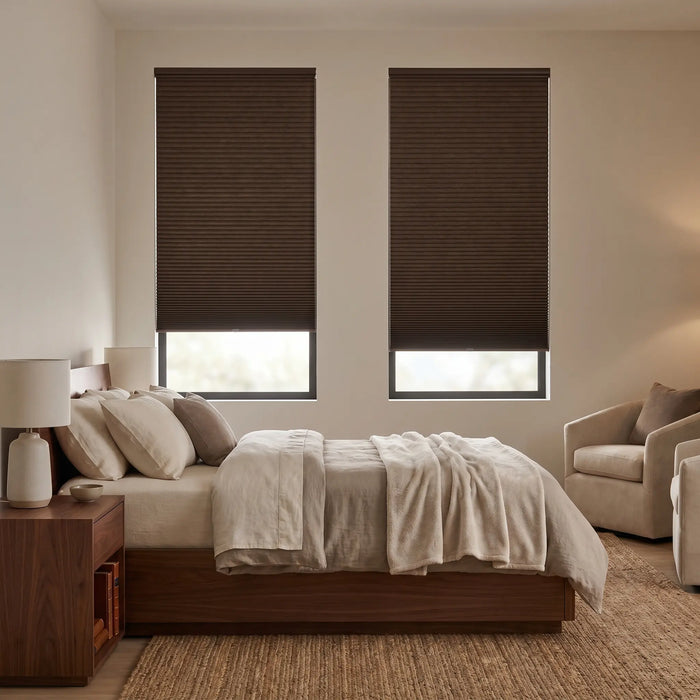
An inside mount means the shade is installed within the window frame. The brackets sit inside the opening, and the shade runs between the side jambs.
People choose inside mount blinds because the look is clean and built-in. You can still show decorative window trim, and the room usually feels less visually busy. For many homes, this is the default choice when the opening has enough depth and no obstructions.
Common advantages of inside mount:
- streamlined appearance
- better fit for rooms with decorative trim
- a tidy profile for modern or minimal interiors
Common trade-offs:
- small side light gaps are normal
- some frames are too shallow for the hardware
- handles, cranks, or tile returns can interfere
Minimum Depth Requirements for Inside Mount Cellular Shades
Before choosing inside mount, measure the available depth from the front edge of the window frame to the glass or nearest obstruction. Different products need different clearance, but the principle is always the same: you need enough depth for the brackets and full shade movement.
Check three points:
- top left
- top center
- top right
Use the smallest depth as your real number. If one point is too shallow, the whole opening behaves like a shallow opening.
Also check for obstructions:
- crank handles
- inward-opening hardware
- alarm sensors
- decorative tile or trim that intrudes into the opening
If depth is marginal, an outside mount often saves time and avoids awkward projection. A shade that is technically installable but poorly cleared can rub, bind, or sit unevenly.
What Is Outside Mount
An outside mount means the shade is installed outside of the window opening, typically on the wall surface or directly on the window trim. The fabric spans wider than the glass area.
With outside mount blinds, you are not constrained by opening depth the same way. This is why outside mounting is popular for shallow windows and for windows with handles that block interior movement.
Common advantages:
- easier fit when frames lack depth
- better coverage that can cover the entire window
- reduced visible light gaps
- flexibility to make small windows look larger
Common trade-offs:
- more visual presence on the wall
- possible trim coverage depending on size
- can project farther into the room
How Outside Mount Affects Light Gaps
Light gaps are one of the most practical reasons people choose outside mount for bedrooms and media rooms. Because the shade extends beyond the opening, it blocks more side leakage than an inside mount setup.
This matters most with blackout fabric. A blackout fabric installed with an inside fit still shows edge glow at the sides. A wider outside mount can reduce that glow significantly, especially when the installer allows proper overlap beyond the glass.
That does not mean inside is wrong. It means the best mount depends on your priority:
- if you want the cleanest architectural look, inside often wins
- if you want maximum light control and privacy, outside often wins
Both approaches can work in the same home. Many people use inside in living spaces and outside in sleep-focused rooms.
Decision Guide by Window Type
Shallow frames
If the opening does not have enough depth, choose outside mount. Forcing inside mount in a shallow opening often creates hardware issues and alignment problems.
Tile surrounds or stone returns
Bathrooms and kitchens sometimes have hard finishes right up to the opening. In these cases, outside mount window treatments are usually simpler because anchors can be set in better material and away from obstruction edges.
Windows with handles or cranks
Casement windows and specialty units can have hardware that blocks shade travel. If the handle projects into the opening, outside mount blinds are often the safer choice unless you have enough recessed clearance behind the hardware.
Deep, square openings in good condition
When the opening is deep and true, inside mount blinds can look polished and intentional. This is often the best fit for rooms where trim detail is part of the design.
Uneven older openings
Older homes may have frames that are out of square. If level lines matter and gaps look inconsistent, outside mounted window setups can visually hide irregularities better than inside installs.
Quick Comparison: Inside vs Outside Mount for Cellular Shades
| Factor | Inside mount | Outside mount |
|---|---|---|
| Depth requirement | Needs enough depth | More forgiving |
| Light gaps | More likely at edges | Better edge coverage |
| Look | Built-in, clean | Layered, more presence |
| Trim visibility | Keeps trim visible | May cover trim |
| Hardware conflicts | More sensitive | Easier to work around |
| Best for | Deep, clean openings | Shallow or obstructed openings |
Is One Always Better?
No. Asking whether inside mount or outside mount is "better" is like asking whether a screwdriver or wrench is better. The right tool depends on the job.
Choose inside when:
- the frame is deep and unobstructed
- you prefer a fitted architectural look
- slight edge light is acceptable
Choose outside when:
- the opening lacks enough depth
- you want less side light leakage
- handles, cranks, or trim details block interior clearance
In many homes, a mixed strategy is smartest. You can mount window treatments differently by room and still keep a cohesive style through consistent fabric and color.
Final Checklist Before You Order
- Measure width and height carefully for the chosen mount
- Confirm available depth if using inside mount
- Decide how much overlap you want for outside mount
- Check clearance for handles, cranks, and sensors
- Prioritize either look, light control, or easiest install
If your goal is the best overall result, start with window conditions first, then style preferences. That sequence prevents costly reorders.
When you are ready to compare options, browse cellular shades and choose the window treatment configuration that matches each opening instead of forcing one setup everywhere. Once mount and fabric are in view, whether cellular shades are worth the cost depends on how you balance comfort, light control, and budget.