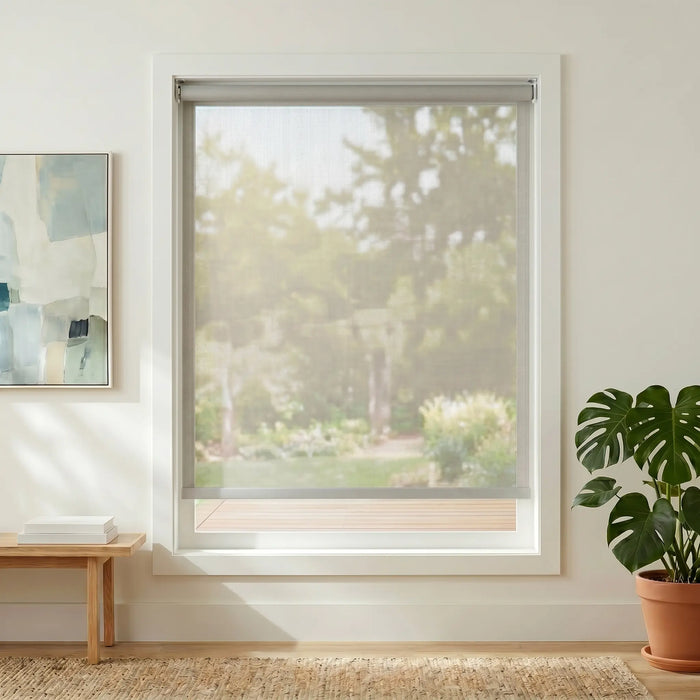
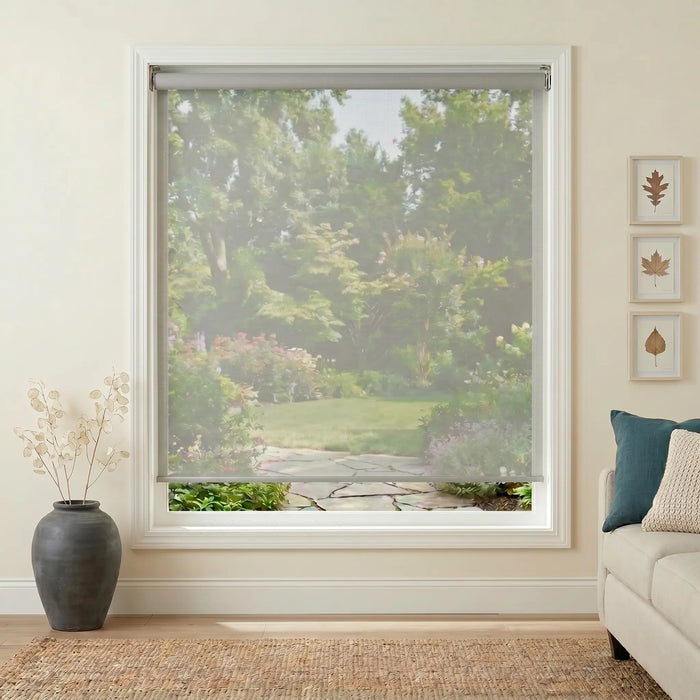
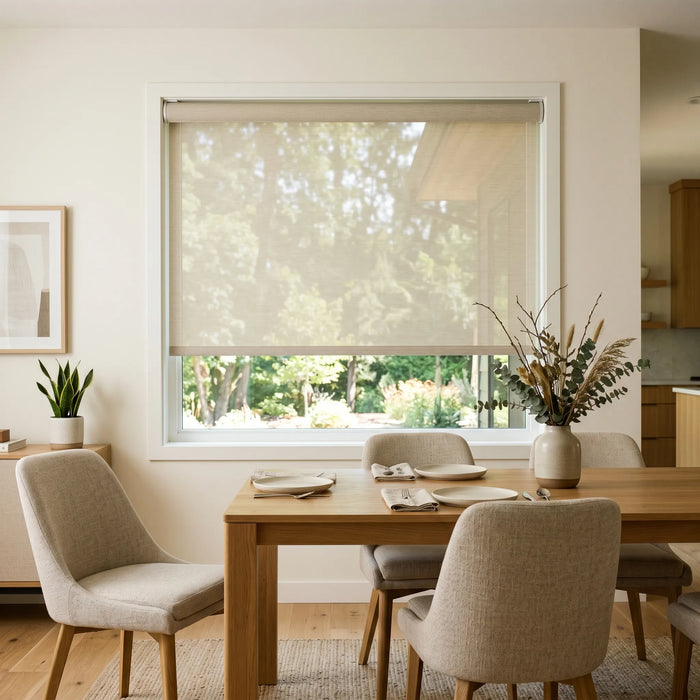
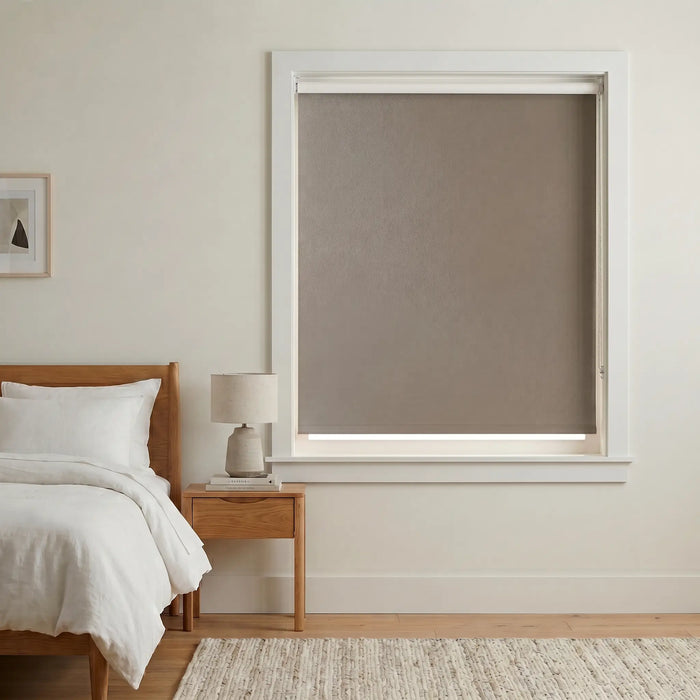
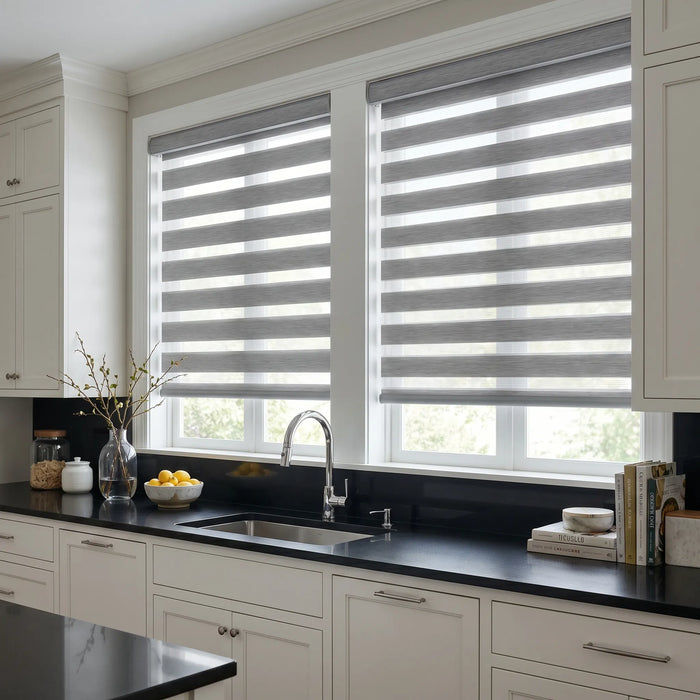
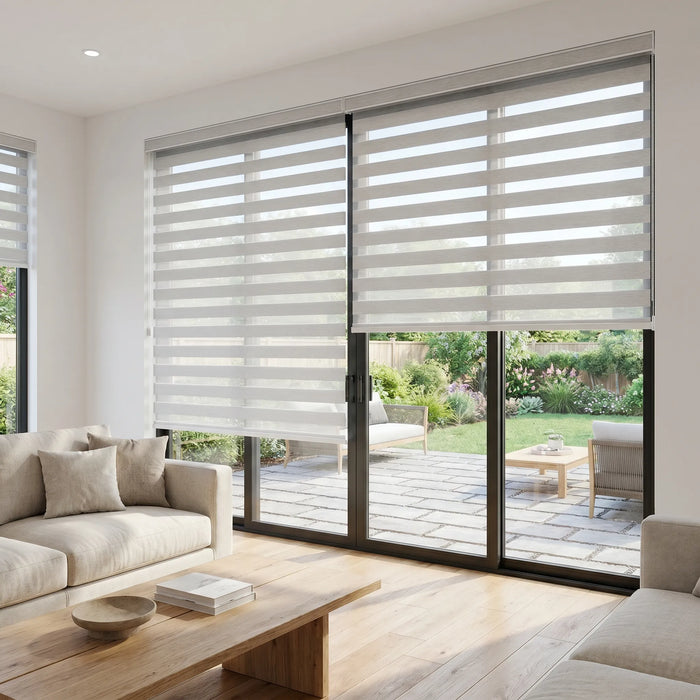
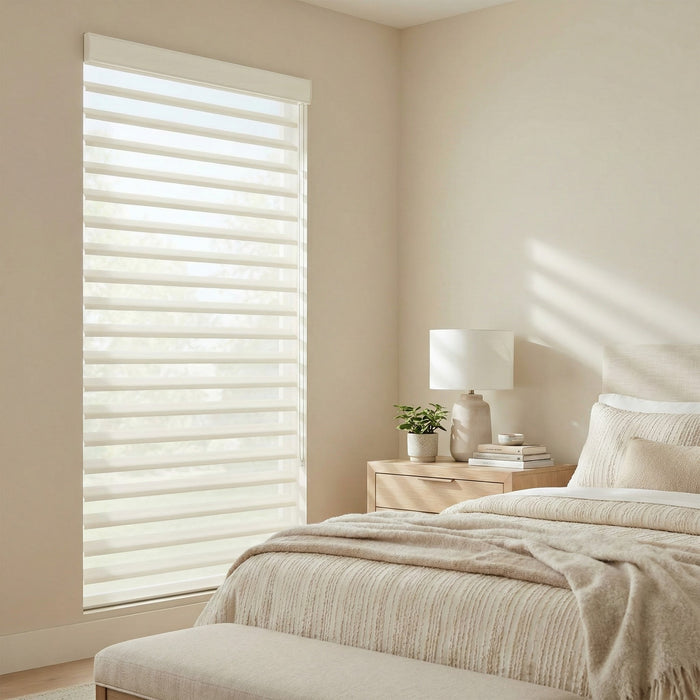
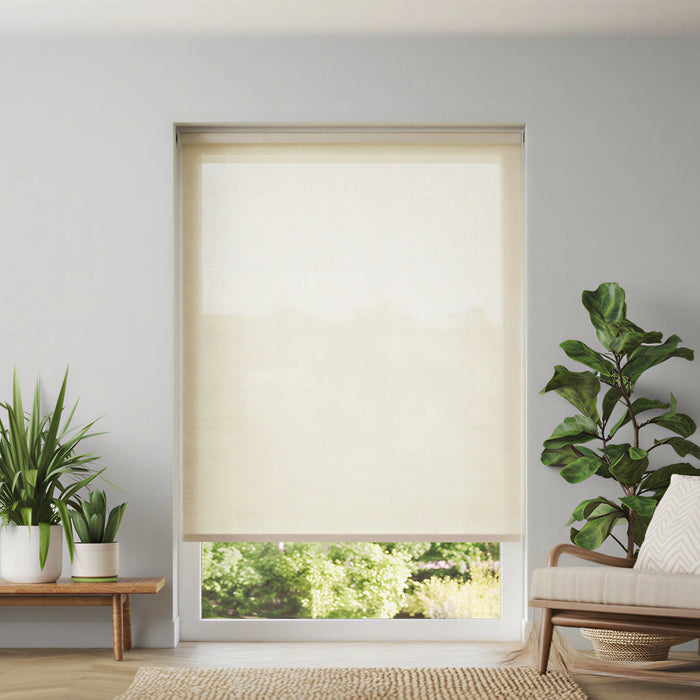
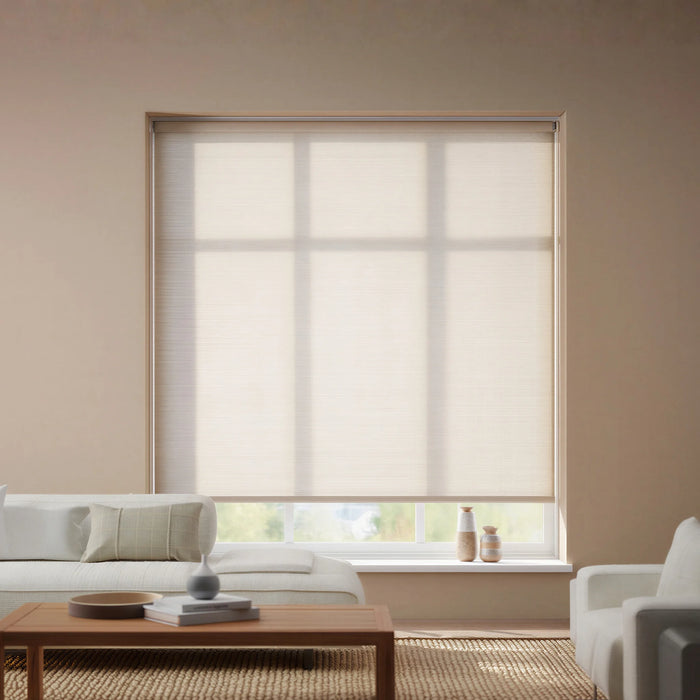
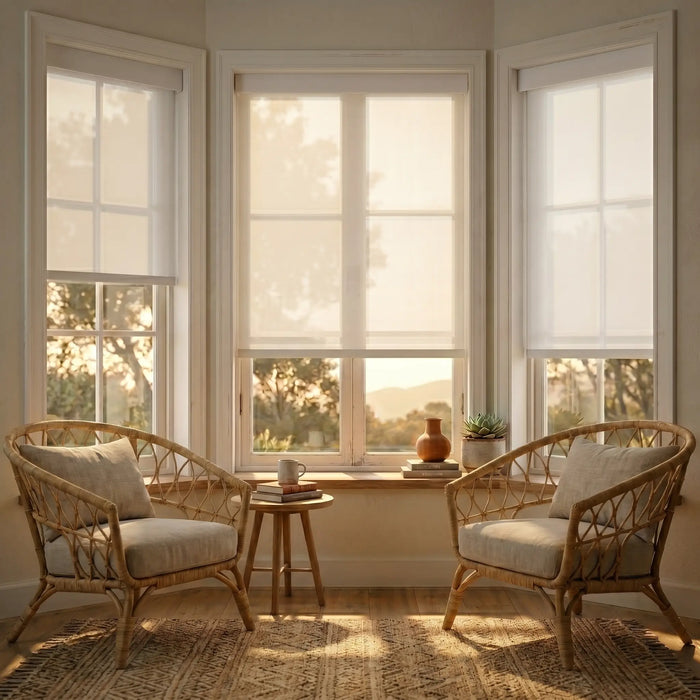
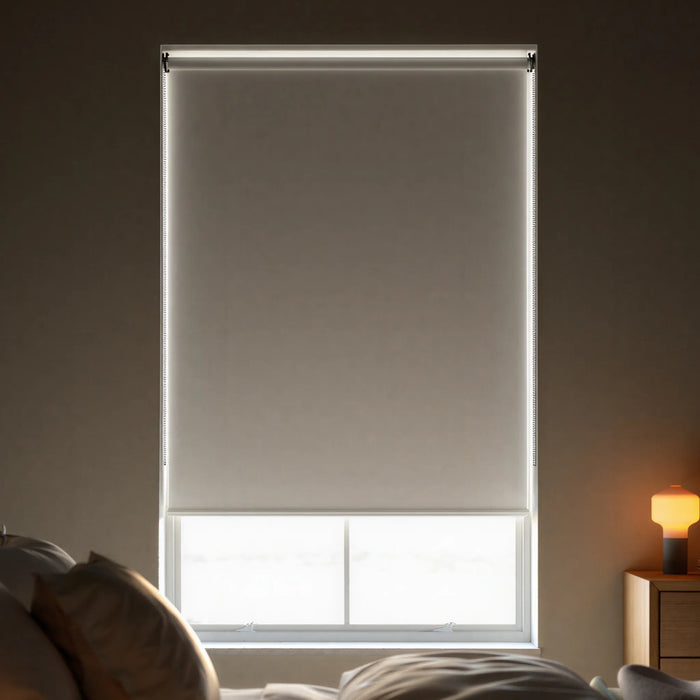
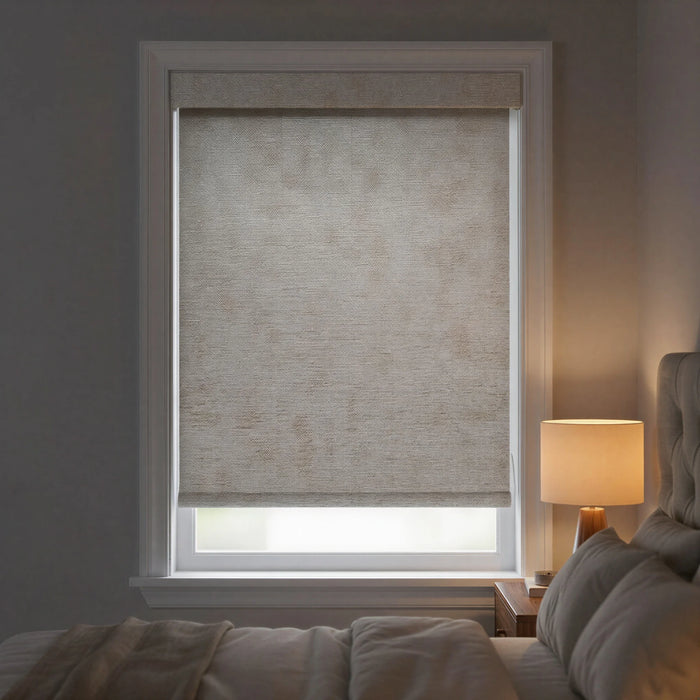
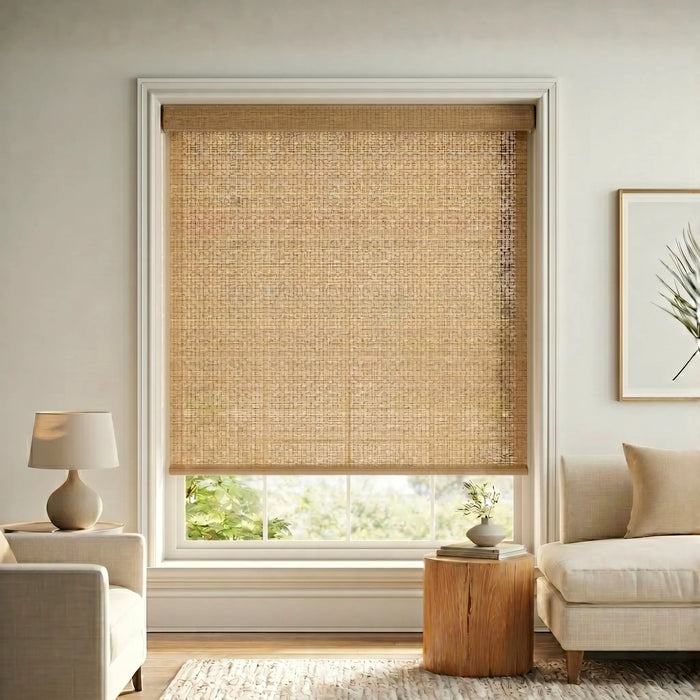
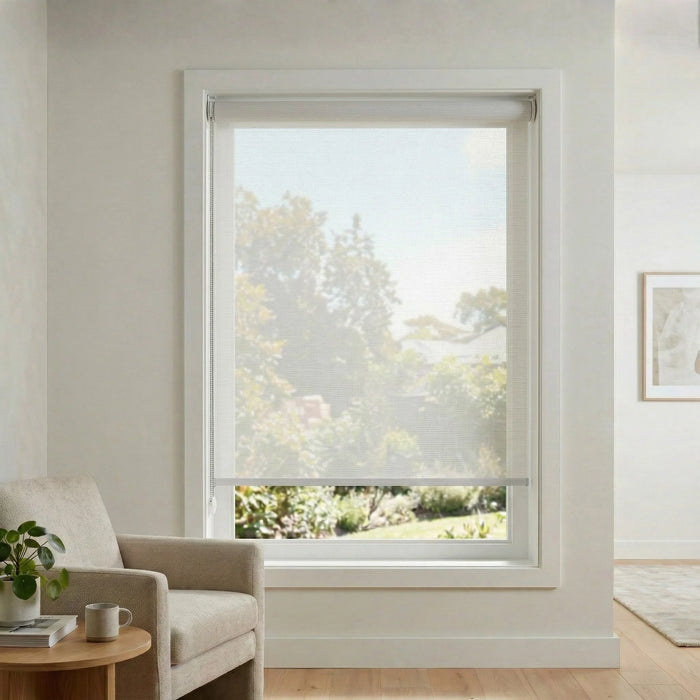
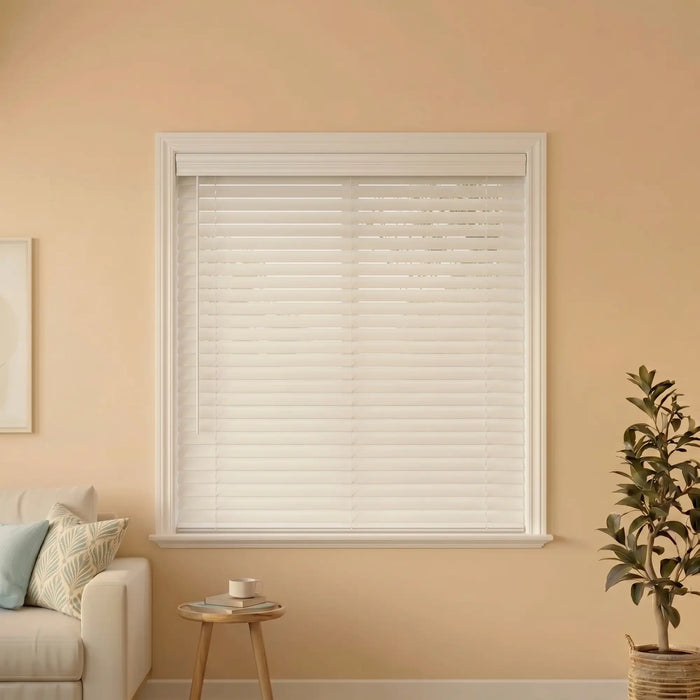
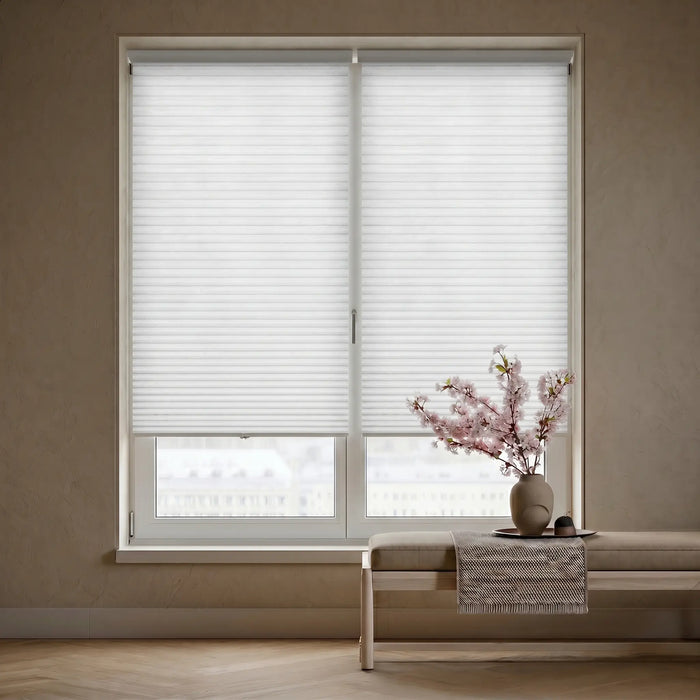
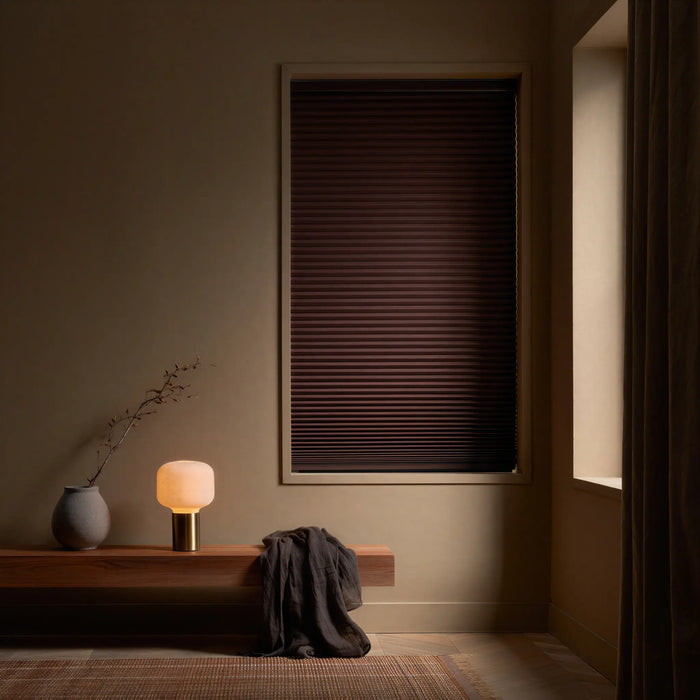
Because the fabric and tube are cut to your finished size, three things decide your order: how much light the fabric passes, how you raise it, and whether it mounts inside the frame or over it.
Light Control: Four Fabrics and One Banded Option
Most complaints about a roller shade trace back to the wrong opacity, so settle this before you look at color.
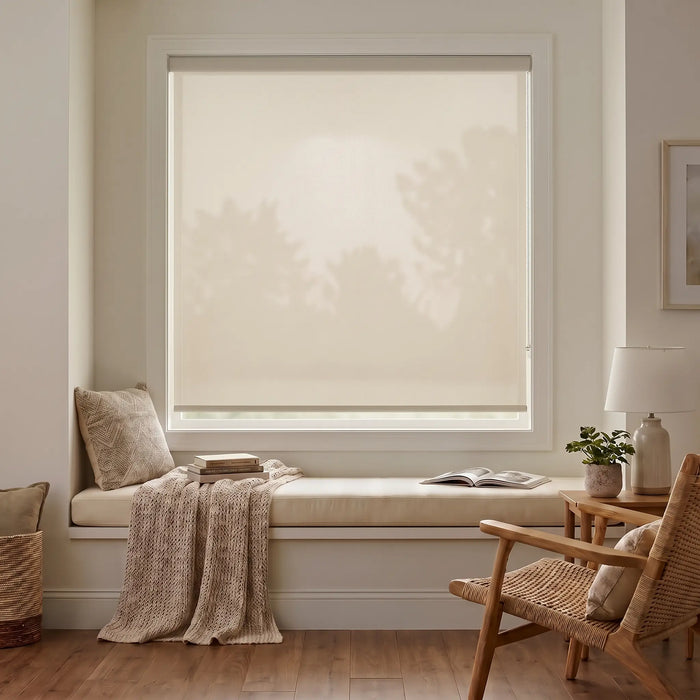
Light filtering: daylight without the glare
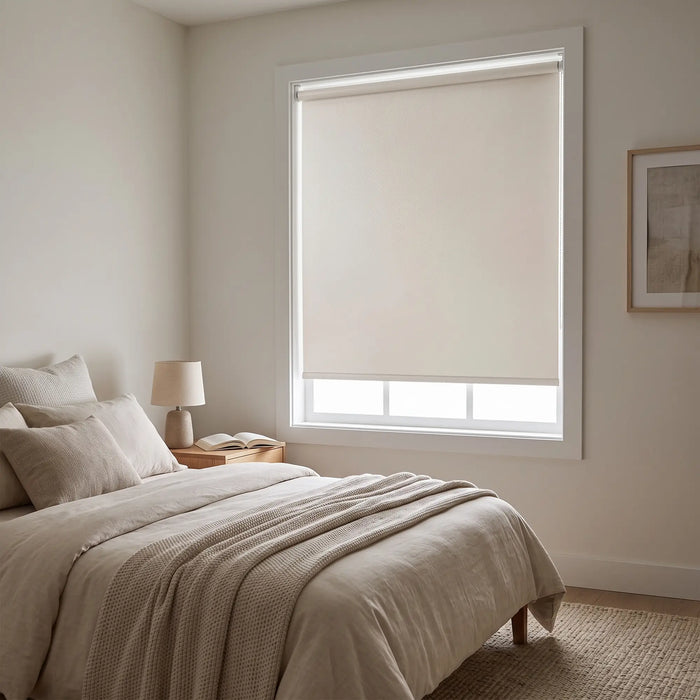
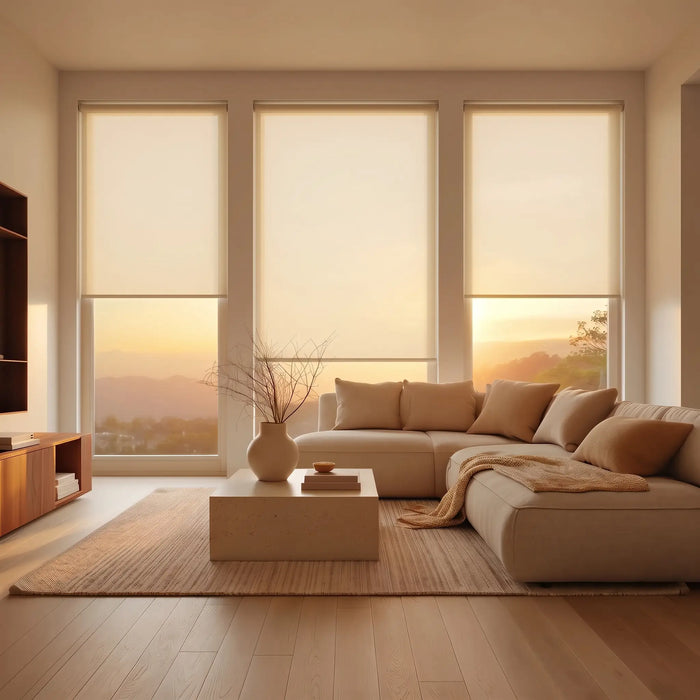
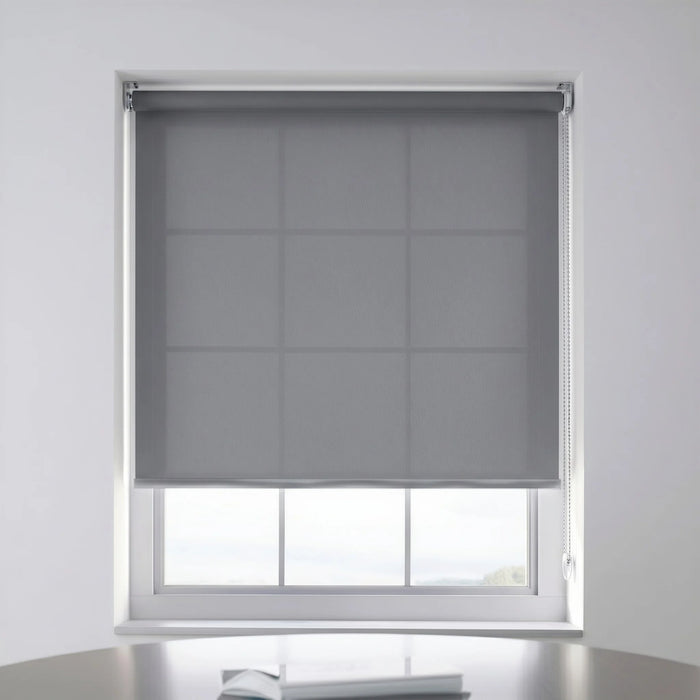
Light filtering fabric passes diffused daylight and blocks the direct beam. The room stays bright, glare comes off screens and glass, and nobody outside sees detail by day. It will not darken a room, and it will not hide a silhouette after dark with the lamps on.
Room darkening and blackout: two different things
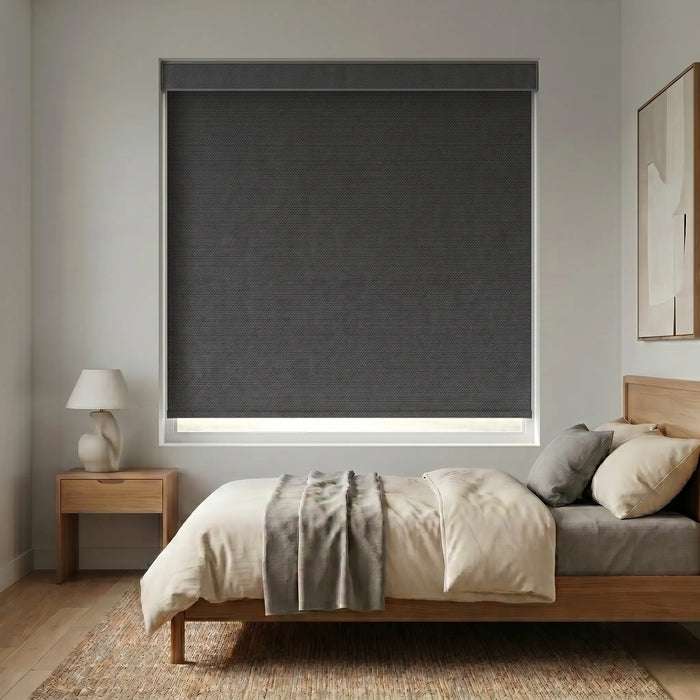
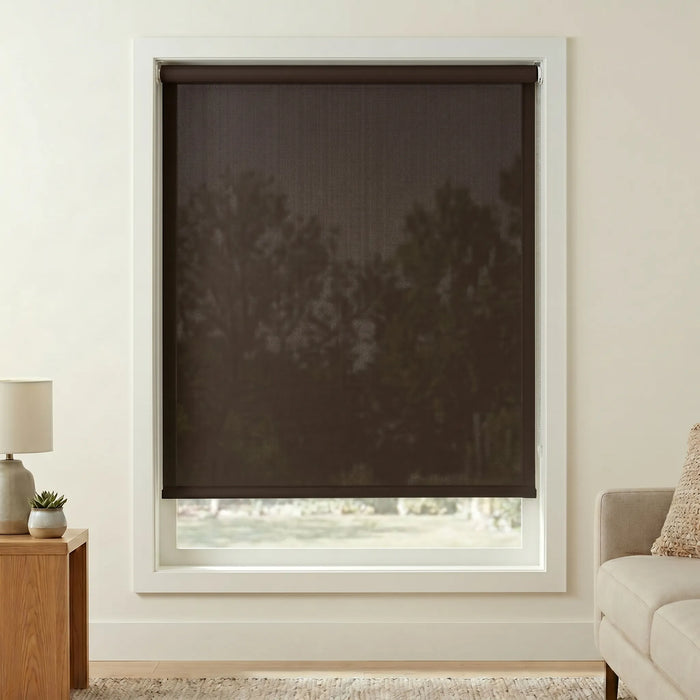
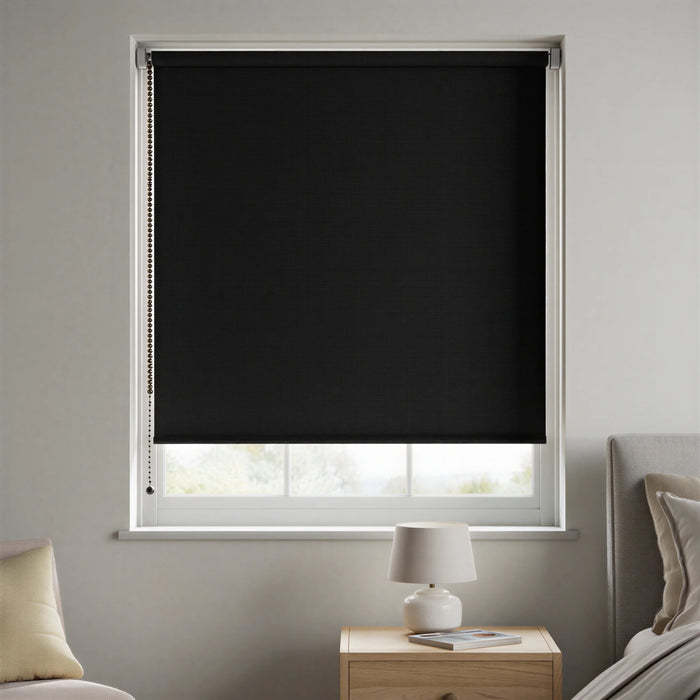
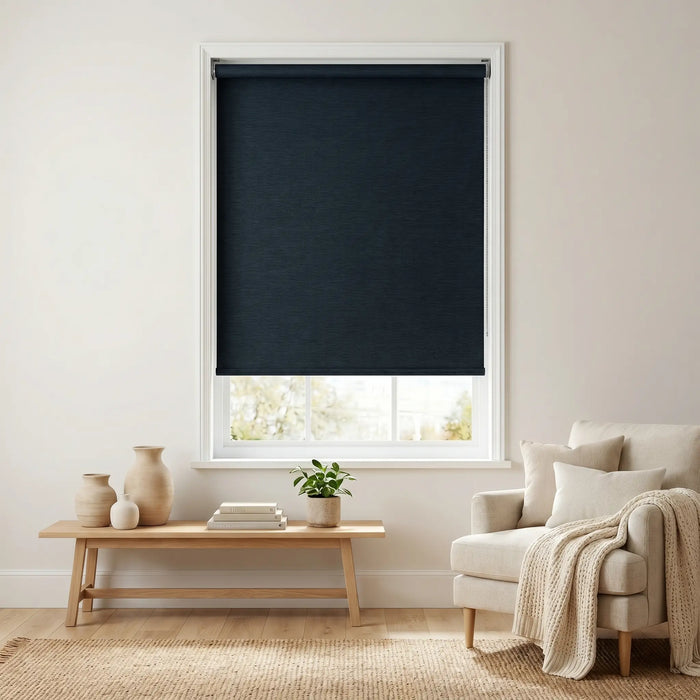
These are two different fabrics, sold as two separate collections. Room darkening fabric takes 85 to 95 percent of the light out of a room without being fully opaque: right for a living room, media wall or light sleeper. Blackout roller shades add a laminated or foam-backed layer and block 99 to 100 percent through the panel, the choice for a main bedroom or nursery.
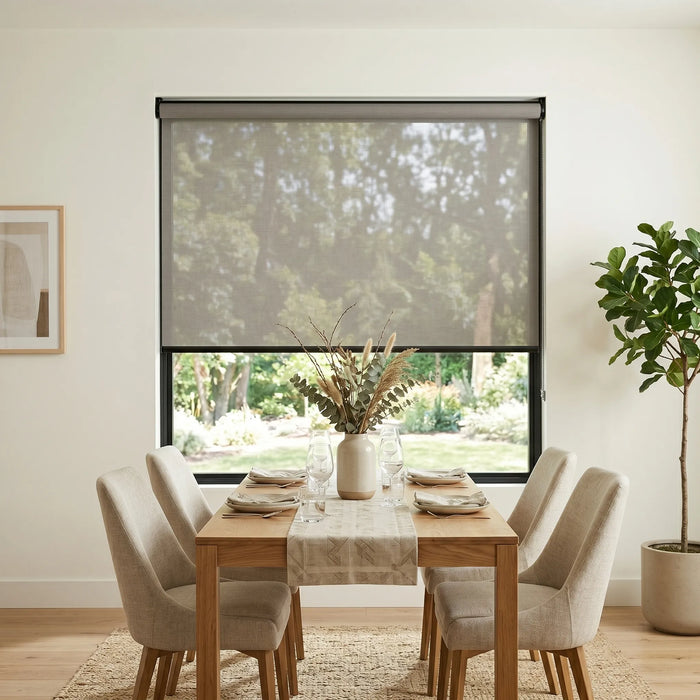
Solar screen: keep the view, cut the heat
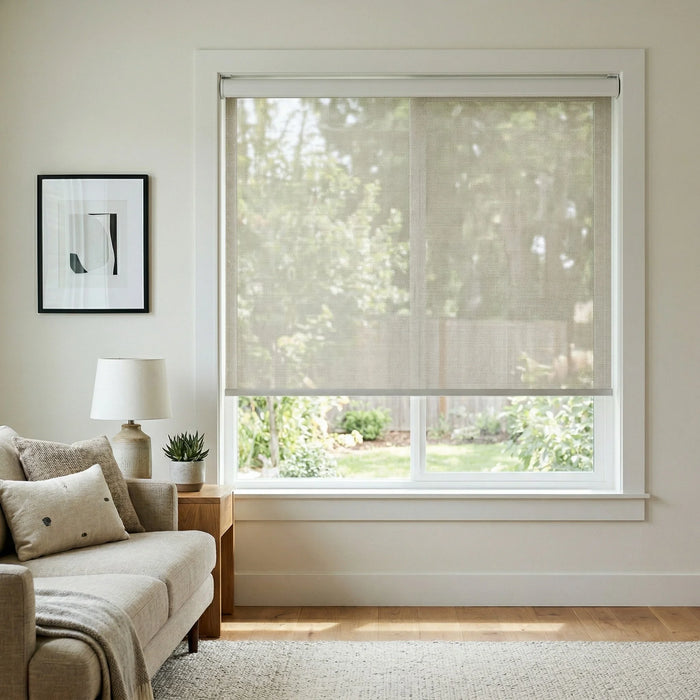
Solar screens use an open woven mesh rated by openness factor: 1, 3, 5, 10 and 14 percent, the proportion of the weave left open. A 1 or 3 percent screen blocks the most heat and gives the tightest privacy, 5 percent is the usual sweet spot, 10 or 14 percent keeps the view crispest. All cut the UV that fades floors and upholstery, which is why solar shades and solar blinds suit a west-facing wall of glass.
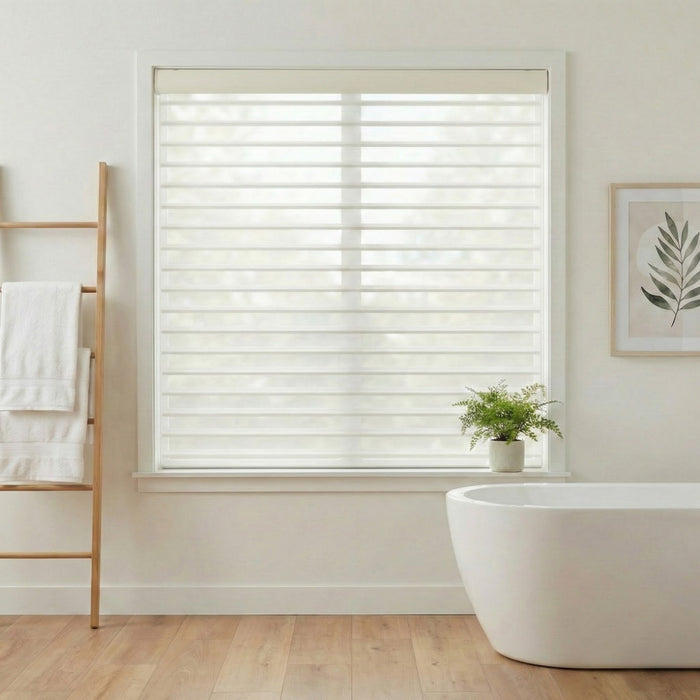
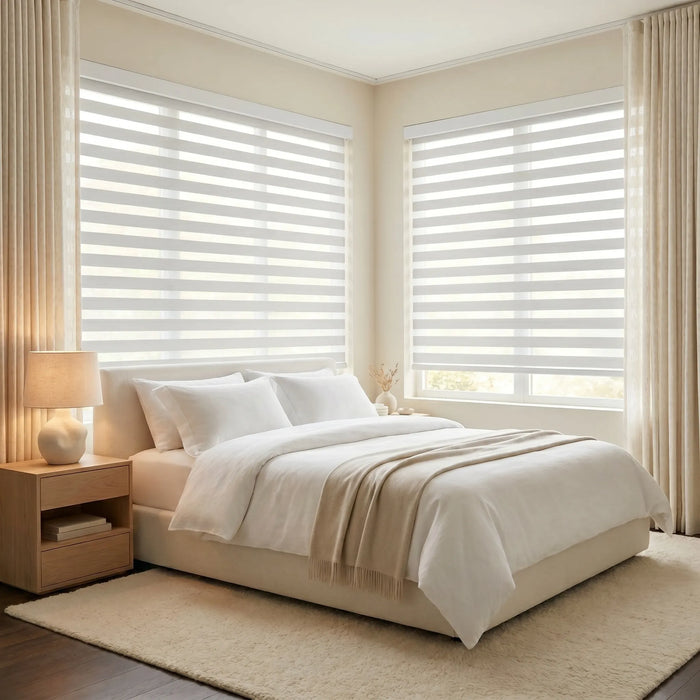
Zebra: two looks on one tube
A zebra shade, also sold as a dual-layer or banded roller, carries alternating sheer and solid stripes on one tube: line the bands up for privacy, offset them for a sheer view-through. See zebra shades.
Fabric, Weight and What Ages Well
Vinyl and vinyl-coated polyester are the wipe-clean workhorses: waterproof, stable, cheapest per square foot. Woven polyester and polyester-linen blends feel like textile, with the widest choice of weaves and prints. PVC-coated fiberglass mesh, the solar screen material, is the most stable and holds a straight edge on wide windows. Light colors hide dust; dark colors run hotter but give a crisper view-through.
Inside Mount or Outside Mount
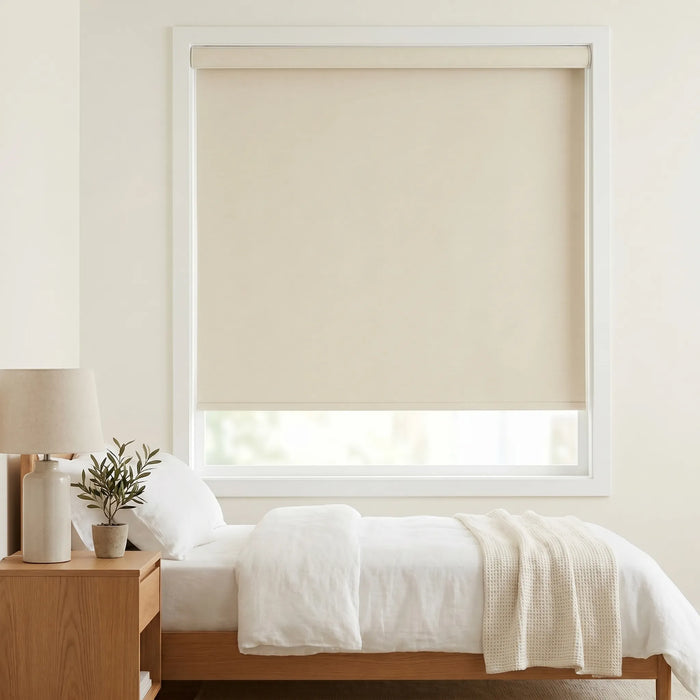
An inside mount sits the brackets within the reveal: cleaner look, trim still visible, and it wants roughly two and a quarter to three inches of flat depth. The fabric is built narrower than the opening so the roll turns freely, which is where light gaps come from.
An outside mount fixes the brackets to the wall or trim face and overlaps the opening on all sides. It suits a shallow reveal and is the only mounting that closes the edge light path: for a bedroom, allow two to three inches of overlap each side, three or more above the head.
Controls: Cordless, Chain Loop and Motorized
Cordless lift
A spring inside the tube is matched to the fabric weight: move the shade by the hem bar and it holds where you let go. No cord, no chain: the right default with young children or pets, and the reason our cordless range is its own collection.
Continuous chain loop
A bead chain over a clutch gives real mechanical advantage, which is what a wide or tall panel wants. Tension the loop to the wall with the supplied cleat so it cannot hang loose, which is compulsory in a room a child or pet uses.
Motorized and smart control
A motor inside the tube, powered by battery, transformer or hardwiring, operated by remote, app, voice or schedule. It earns its price on high transoms, stairwell glass, shades that move together and windows behind furniture. See our motorized range if a whole room goes on one schedule.
Room by Room
Bathrooms and kitchens play to a roller's strengths: no folds to trap moisture, no sewn channels to mildew, and a vinyl face wipes clean over a tub or sink. Bedrooms and nurseries want blackout fabric, an outside mount and no reachable cord, the combination our nursery collection is built around.
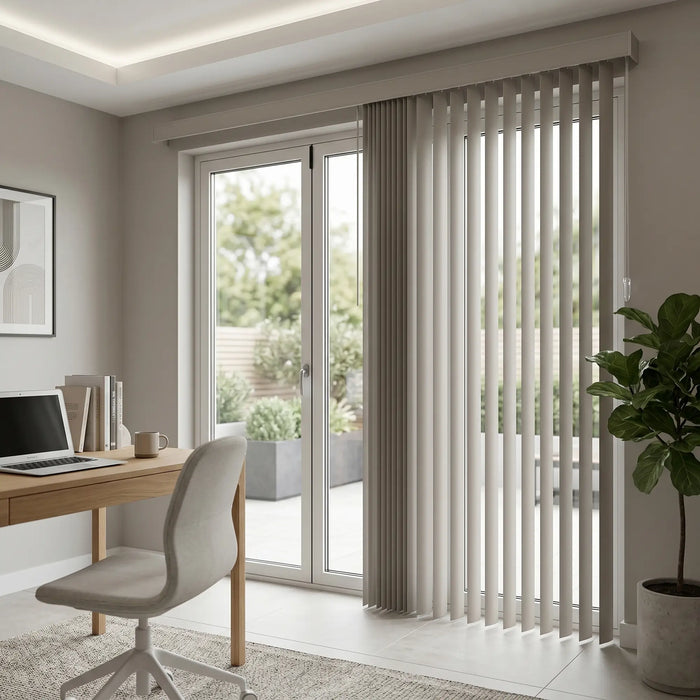
Patio sliders and wide glass walls suit rollers well. Depending on the fabric line, one panel spans roughly 103 to 115 inches, enough for most standard patio doors, and we build a dedicated range for sliding glass doors. Beyond that, mount two or more panels side by side. If you would rather draw the covering sideways, which some prefer on a door in constant use, vertical blinds do that instead.
The trade-offs no one tells you about, but we will
Side light gaps are structural, not a defect: an inside-mounted roller has to clear its own brackets, so the fabric ends up slightly narrower with visible light gaps. Nobody notices on light filtering fabric; on blackout in a dark bedroom the eye locks onto them. Decide before you order: outside mount, side channels, or live with the lines.
Width has a practical ceiling: past roughly seven to eight feet of span, one panel can wind unevenly and drift sideways, and a shade that starts hanging crooked is hard to put right once it is installed. Splitting a wide opening into two shades is not a compromise; on a big window it is a better option, and gives more light control also. Our shades for sliding glass doors are sized with this in mind.
Solar screens also reverse after dark: by day you see out, and once your lights are on, people outside see in. Plan a second layer with another roller shade or some drapery if the window faces a sidewalk and you are concerned about privacy.
Measuring, Installing and Cleaning
Measure width and height in three places each. For an inside mount, use the narrowest width and the longest height: give us the raw opening size and let us take the deduction, rather than deducting yourself. For an outside mount, give us the finished size you want, overlap included. Watch for cranks and deep sills the tube could foul. Our guide on how to measure for roller shades covers both.
Installation is two brackets, a level and a tube that snaps in. Fix into the frame or solid blocking rather than drywall alone, and get the brackets dead level. Every few weeks, run a vacuum brush or dry microfiber cloth down both faces. Vinyl and screen fabrics also take a damp cloth with mild soap; woven fabrics are spot-clean only. Never soak a roller shade: water wicks into the roll and dries with a tide line.
 Skip to content